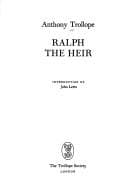
Domestic fiction; England -- Fiction; Fathers and sons -- Fiction; Inheritance and succession -- Fiction
Throughout November he allowed his horses to remain at the Moonbeam,
being somewhat in doubt whether or no he would return to that
fascinating hostelrie. He received one or two most respectful letters
from Mr. Horsball, in which glowing accounts were given of the sport
of the season, and the health of his horses, and offers made of most
disinterested services. Rooms should be ready for him at a moment's
notice if he liked at any time to run over for a week's hunting. It
was quite evident that in the eyes of Mr. Horsball Newton of Newton
was a great man. And there came congratulations from Mr. Cox, in
which no allusion whatever was made to the Squire's somewhat uncivil
conduct at their last meeting. Mr. Cox trusted that his dearest
friend would come over and have another spell at the Moonbeam before
he settled down for life;--and then hinted in language that was
really delicate in the niceness of its expression, that if he, Cox,
were but invited to spend a week or two at Newton Priory before he
banished himself for life to Australia, he would be able to make
his way over the briny deep with a light heart and an uncomplaining
tongue. "You know, old fellow, how true I've always been to you,"
wrote Cox, in language of the purest friendship. "As true as
steel,--to sausages in the morning and brandy and soda at night,"
said Ralph to himself as he read this.
He behaved with thorough kindness to his cousin. The three men lived
together for a month, and their intercourse was as pleasant as was
possible under the circumstances. Of course there was no hunting
during this month at Newton. Nor indeed did the heir see a hound till
December, although, as the reader is aware, he was not particularly
bound to revere his uncle's memory. He made many overtures to his
namesake. He would be only too happy if his cousin,--he always called
the Squire's son his cousin,--would make Newton his home for the
next twelvemonth. It was found that the Squire had left behind him
something like forty thousand pounds, so that the son was by no means
to be regarded as a poor man. It was his idea at present that he
would purchase in some pleasant county as much land as he might
farm himself, and there set up his staff for life. "And get about
two-and-a-half per cent. for your money," said the heir, who was
beginning to consider himself learned in such matters, and could talk
of land as a very serious thing in the way of a possession.
"What else am I to do?" said the other. "Two-and-a-half per cent.
with an occupation is better than five per cent. with none. I should
make out the remainder, too, by farming the land myself. There is
nothing else in the world that I could do."
Public-domain text, read in full here on John Shaqi.
Reviews
Reviews
No reviews yet
Be the first to share your thoughts on this work.
Elsewhere in the archive
Join the Discussion
Join the discussion
Sign in to leave a comment or review.
Sign InorCreate an account