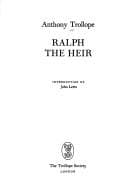
Domestic fiction; England -- Fiction; Fathers and sons -- Fiction; Inheritance and succession -- Fiction
Thoughts of maiden boldness flitted across her mind, but she
could not communicate them even to the girls who were her friends.
Yet in silence and in solitude she resolved that the time should come
in which she would be bold.
Then young Newton's second letter reached the house, and that also
had been read to her. "He is quite right," said Sir Thomas. "Of
course it releases both of you."
"There was nothing to release," said Mary, proudly.
"I mean to say that having made such a proposition as was contained
in his first letter, he was bound to explain his altered position."
"I suppose so," said Mary.
"Of course he was. He had made his offer believing that he could make
you mistress of Newton Priory,--and he had made it thinking that he
himself could marry in that position. And he would have been in that
position had not this most unforeseen and terrible calamity have
occurred."
"I do not see that it makes any difference," said Mary, in a whisper.
"What do you mean, my dear?"
"I hardly know, uncle."
"Try to explain yourself, Mary."
"If I had accepted any man when he was rich, I should not go back
when he was poor,--unless he wanted it." This also she said in a
whisper.
"But you had not accepted him."
"No," said Mary, still in a whisper. Sir Thomas, who was perhaps not
very good at such things, did not understand the working of her mind.
But had she dared, she would have asked her uncle to tell Mr. Newton
to come and see her. Sir Thomas, having some dim inkling of what
perhaps might be the case, did add a paragraph to his letter in which
he notified to his correspondent that a personal visit would be taken
in good part.
Public-domain text, read in full here on John Shaqi.
Reviews
Reviews
No reviews yet
Be the first to share your thoughts on this work.
Elsewhere in the archive
Join the Discussion
Join the discussion
Sign in to leave a comment or review.
Sign InorCreate an account