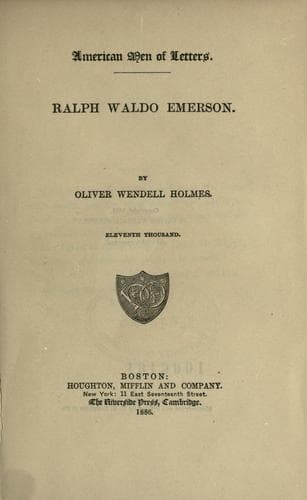
Authors, American -- 19th century -- Biography; Emerson, Ralph Waldo, 1803-1882
In reading some of Emerson's pages it seems as if another Arcadia, or
the new Atlantis, had emerged as the fortunate island of Great Britain,
or that he had reached a heaven on earth where neither moth nor rust
doth corrupt, and where thieves do not break through nor steal,--or if
they do, never think of denying that they have done it. But this was a
generation ago, when the noun "shoddy," and the verb "to scamp," had not
grown such familiar terms to English ears as they are to-day. Emerson
saw the country on its best side. Each traveller makes his own England.
A Quaker sees chiefly broad brims, and the island looks to him like a
field of mushrooms.
The transplanted Church of England is rich and prosperous and
fashionable enough not to be disturbed by Emerson's flashes of light
that have not come through its stained windows.
"The religion of England is part of good-breeding. When you see on
the continent the well-dressed Englishman come into his ambassador's
chapel, and put his face for silent prayer into his smooth-brushed
hat, one cannot help feeling how much national pride prays with him,
and the religion of a gentleman.
"The church at this moment is much to be pitied. She has nothing
left but possession. If a bishop meets an intelligent gentleman, and
reads fatal interrogation in his eyes, he has no resource but to
take wine with him."
Sydney Smith had a great reverence for a bishop,--so great that he told
a young lady that he used to roll a crumb of bread in his hand, from
nervousness, when he sat next one at a dinner-table,--and if next an
archbishop, used to roll crumbs with both hands,---but Sydney Smith
would have enjoyed the tingling felicity of this last stinging touch
of wit, left as lightly and gracefully as a _banderillero_ leaves his
little gayly ribboned dart in the shoulders of the bull with whose
unwieldy bulk he is playing.
Emerson handles the formalism and the half belief of the Established
Church very freely, but he closes his chapter on Religion with
soft-spoken words.
"Yet if religion be the doing of all good, and for its sake
the suffering of all evil, _souffrir de tout le monde,
et ne faire souffrir personne,_ that divine secret has existed in
England from the days of Alfred to those of Romilly, of Clarkson,
and of Florence Nightingale, and in thousands who have no fame."
"English Traits" closes with Emerson's speech at Manchester, at the
annual banquet of the "Free Trade Athenaeum." This was merely an
occasional after-dinner reply to a toast which called him up, but it had
sentences in it which, if we can imagine Milton to have been called up
in the same way, he might well have spoken and done himself credit in
their utterance.
* * * * *
Public-domain text, read in full here on John Shaqi.
Reviews
Reviews
No reviews yet
Be the first to share your thoughts on this work.
Elsewhere in the archive
Join the Discussion
Join the discussion
Sign in to leave a comment or review.
Sign InorCreate an account