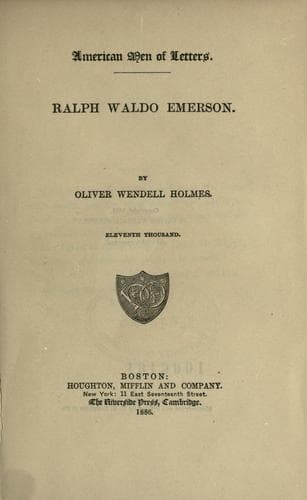
Authors, American -- 19th century -- Biography; Emerson, Ralph Waldo, 1803-1882
"'Incertainties now crown themselves assured,
And Peace proclaims olives of endless age.'"
The "Conduct of Life" was published in 1860. The chapter on "Fate" might
leave the reader with a feeling that what he is to do, as well as what
he is to be and to suffer, is so largely predetermined for him, that
his will, though formally asserted, has but a questionable fraction in
adjusting him to his conditions as a portion of the universe. But let
him hold fast to this reassuring statement:--
"If we must accept Fate, we are not less compelled to affirm
liberty, the significance of the individual, the grandeur of duty,
the power of character.--We are sure, that, though we know not how,
necessity does comport with liberty, the individual with the world,
my polarity with the spirit of the times."
But the value of the Essay is not so much in any light it throws on the
mystery of volition, as on the striking and brilliant way in which the
limitations of the individual and the inexplicable rule of law are
illustrated.
"Nature is no sentimentalist,--does not cosset or pamper us. We must
see that the world is rough and surly, and will not mind drowning a
man or a woman; but swallows your ship like a grain of dust.--The
way of Providence is a little rude. The habit of snake and spider,
the snap of the tiger and other leapers and bloody jumpers, the
crackle of the bones of his prey in the coil of the anaconda,--these
are in the system, and our habits are like theirs. You have just
dined, and however scrupulously the slaughterhouse is concealed in
the graceful distance of miles, there is complicity,--expensive
races,--race living at the expense of race.--Let us not deny it up
and down. Providence has a wild, rough, incalculable road to its
end, and it is of no use to try to whitewash its huge, mixed
instrumentalities, or to dress up that terrific benefactor in a
clean shirt and white neckcloth of a student in divinity."
Emerson cautions his reader against the danger of the doctrines which he
believed in so fully:--
"They who talk much of destiny, their birth-star, etc., are in a
lower dangerous plane, and invite the evils they fear."
But certainly no physiologist, no cattle-breeder, no Calvinistic
predestinarian could put his view more vigorously than Emerson, who
dearly loves a picturesque statement, has given it in these words,
which have a dash of science, a flash of imagination, and a hint of the
delicate wit that is one of his characteristics:--
"People are born with the moral or with the material bias;--uterine
brothers with this diverging destination: and I suppose, with
high magnifiers, Mr. Fraunhofer or Dr. Carpenter might come to
distinguish in the embryo at the fourth day, this is a whig and that
a free-soiler."
Let us see what Emerson has to say of "Power:"--
Public-domain text, read in full here on John Shaqi.
Reviews
Reviews
No reviews yet
Be the first to share your thoughts on this work.
Elsewhere in the archive
Join the Discussion
Join the discussion
Sign in to leave a comment or review.
Sign InorCreate an account