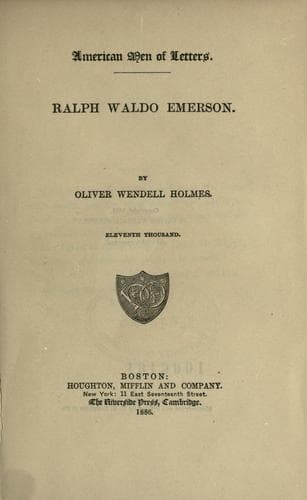
Authors, American -- 19th century -- Biography; Emerson, Ralph Waldo, 1803-1882
Nothing could be more wholesome in a meeting of creed-killers than the
suggestive remark,--
--"What I expected to find here was, some practical suggestions by
which we were to reanimate and reorganize for ourselves the true
Church, the pure worship. Pure doctrine always bears fruit in pure
benefits. It is only by good works, it is only on the basis of
active duty, that worship finds expression.--The interests that grow
out of a meeting like this, should bind us with new strength to the
old eternal duties."
In a later address before the same association, Emerson says:--
"I object, of course, to the claim of miraculous
dispensation,--certainly not to the _doctrine_ of Christianity.--If
you are childish and exhibit your saint as a worker of wonders, a
thaumaturgist, I am repelled. That claim takes his teachings out of
nature, and permits official and arbitrary senses to be grafted on
the teachings."
The "Progress of Culture" was delivered as a Phi Beta Kappa oration just
thirty years after his first address before the same society. It is very
instructive to compare the two orations written at the interval of a
whole generation: one in 1837, at the age of thirty-four; the other in
1867, at the age of sixty-four. Both are hopeful, but the second is more
sanguine than the first. He recounts what he considers the recent gains
of the reforming movement:--
"Observe the marked ethical quality of the innovations urged or
adopted. The new claim of woman to a political status is itself an
honorable testimony to the civilization which has given her a civil
status new in history. Now that by the increased humanity of law she
controls her property, she inevitably takes the next step to her
share in power."
He enumerates many other gains, from the war or from the growth of
intelligence,--"All, one may say, in a high degree revolutionary,
teaching nations the taking of governments into their own hands, and
superseding kings."
He repeats some of his fundamental formulae.
"The foundation of culture, as of character, is at last the moral
sentiment.
"Great men are they who see that spiritual is stronger than any
material force, that thoughts rule the world.
"Periodicity, reaction, are laws of mind as well as of matter."
And most encouraging it is to read in 1884 what was written in
1867,--especially in the view of future possibilities. "Bad kings and
governors help us, if only they are bad enough." _Non tali auxilio_, we
exclaim, with a shudder of remembrance, and are very glad to read these
concluding words: "I read the promise of better times and of greater
men."
In the year 1866, Emerson reached the age which used to be spoken of as
the "grand climacteric." In that year Harvard University conferred upon
him the degree of Doctor of Laws, the highest honor in its gift.
Public-domain text, read in full here on John Shaqi.
Reviews
Reviews
No reviews yet
Be the first to share your thoughts on this work.
Elsewhere in the archive
Join the Discussion
Join the discussion
Sign in to leave a comment or review.
Sign InorCreate an account