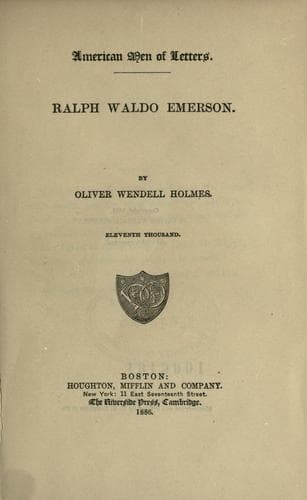
Authors, American -- 19th century -- Biography; Emerson, Ralph Waldo, 1803-1882
"Now, though I am by no means sure that the reader will assent to
all my propositions, yet I think we shall agree in my first rule for
success,--that we shall drop the brag and the advertisement and take
Michael Angelo's course, 'to confide in one's self and be something
of worth and value.'"
Reading about "Success" is after all very much like reading in old books
of alchemy. "How not to do it," is the lesson of all the books and
treatises. Geber and Albertus Magnus, Roger Bacon and Raymond Lully, and
the whole crew of "pauperes alcumistae," all give the most elaborate
directions showing their student how to fail in transmuting Saturn into
Luna and Sol and making a billionaire of himself. "Success" in its
vulgar sense,--the gaining of money and position,--is not to be reached
by following the rules of an instructor. Our "self-made men," who govern
the country by their wealth and influence, have found their place by
adapting themselves to the particular circumstances in which they were
placed, and not by studying the broad maxims of "Poor Richard," or any
other moralist or economist.--For such as these is meant the cheap
cynical saying quoted by Emerson, "_Rien ne réussit mieux que le
succès_."
But this is not the aim and end of Emerson's teaching:--
"I fear the popular notion of success stands in direct opposition
in all points to the real and wholesome success. One adores public
opinion, the other private opinion; one fame, the other desert; one
feats, the other humility; one lucre, the other love; one monopoly,
and the other hospitality of mind."
And so, though there is no alchemy in this Lecture, it is profitable
reading, assigning its true value to the sterling gold of character,
the gaining of which is true success, as against the brazen idol of the
market-place.
The Essay on "Old Age" has a special value from its containing two
personal reminiscences: one of the venerable Josiah Quincy, a brief
mention; the other the detailed record of a visit in the year 1825,
Emerson being then twenty-two years old, to ex-President John Adams,
soon after the election of his son to the Presidency. It is enough to
allude to these, which every reader will naturally turn to first of all.
But many thoughts worth gathering are dropped along these pages. He
recounts the benefits of age; the perilous capes and shoals it has
weathered; the fact that a success more or less signifies little, so
that the old man may go below his own mark with impunity; the feeling
that he has found expression,--that his condition, in particular and in
general, allows the utterance of his mind; the pleasure of completing
his secular affairs, leaving all in the best posture for the future:--
Public-domain text, read in full here on John Shaqi.
Reviews
Reviews
No reviews yet
Be the first to share your thoughts on this work.
Elsewhere in the archive
Join the Discussion
Join the discussion
Sign in to leave a comment or review.
Sign InorCreate an account