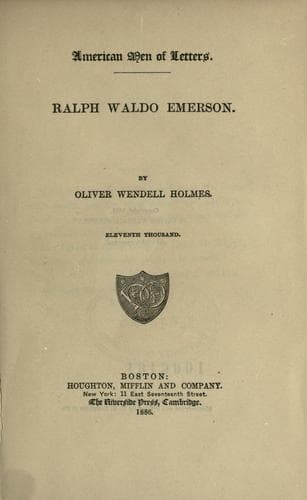
Authors, American -- 19th century -- Biography; Emerson, Ralph Waldo, 1803-1882
A near friend of mine, a lady, was once in the cars with Emerson, and
when they stopped for the refreshment of the passengers he was very
desirous of procuring something at the station for her solace. Presently
he advanced upon her with a cup of tea in one hand and a wedge of pie in
the other,--such a wedge! She could hardly have been more dismayed
if one of Caesar's _cunei_, or wedges of soldiers, had made a charge
against her.
Yet let me say here that pie, often foolishly abused, is a good
creature, at the right time and in angles of thirty or forty degrees. In
semicircles and quadrants it may sometimes prove too much for delicate
stomachs. But here was Emerson, a hopelessly confirmed pie-eater, never,
so far as I remember, complaining of dyspepsia; and there, on the other
side, was Carlyle, feeding largely on wholesome oatmeal, groaning with
indigestion all his days, and living with half his self-consciousness
habitually centred beneath his diaphragm.
Like his friend Carlyle and like Tennyson, Emerson had a liking for a
whiff of tobacco-smoke:--
"When alone," he said, "he rarely cared to finish a whole cigar. But
in company it was singular to see how different it was. To one who
found it difficult to meet people, as he did, the effect of a cigar
was agreeable; one who is smoking may be as silent as he likes, and
yet be good company. And so Hawthorne used to say that he found it.
On this journey Mr. Emerson generally smoked a single cigar after
our mid-day dinner, or after tea, and occasionally after both. This
was multiplying, several times over, anything that was usual with
him at home."
Professor Thayer adds in a note:--
"Like Milton, Mr. Emerson 'was extraordinary temperate in his Diet,'
and he used even less tobacco. Milton's quiet day seems to have
closed regularly with a pipe; he 'supped,' we are told, 'upon ...
some light thing; and after a pipe of tobacco and a glass of water
went to bed.'"
As Emerson's name has been connected with that of Milton in its nobler
aspects, it can do no harm to contemplate him, like Milton, indulging in
this semi-philosophical luxury.
One morning in July, 1872, Mr. and Mrs. Emerson woke to find their room
filled with smoke and fire coming through the floor of a closet in the
room over them. The alarm was given, and the neighbors gathered and did
their best to put out the flames, but the upper part of the house was
destroyed, and with it were burned many papers of value to Emerson,
including his father's sermons. Emerson got wet and chilled, and it
seems too probable that the shock hastened that gradual loss of memory
which came over his declining years.
His kind neighbors did all they could to save his property and relieve
his temporary needs. A study was made ready for him in the old Court
House, and the "Old Manse," which had sheltered his grandfather, and
others nearest to him, received him once more as its tenant.
Public-domain text, read in full here on John Shaqi.
Reviews
Reviews
No reviews yet
Be the first to share your thoughts on this work.
Elsewhere in the archive
Join the Discussion
Join the discussion
Sign in to leave a comment or review.
Sign InorCreate an account