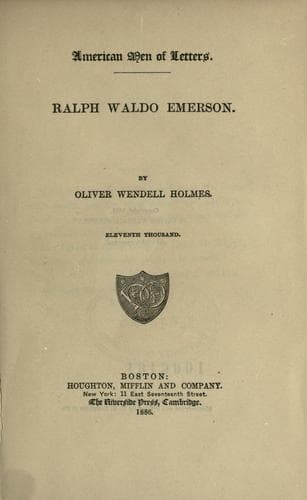
Authors, American -- 19th century -- Biography; Emerson, Ralph Waldo, 1803-1882
The Lecture on "American Civilization," made up from two Addresses, one
of which was delivered at Washington on the 31st of January, 1862, is,
as might be expected, full of anti-slavery. That on the "Emancipation
Proclamation," delivered in Boston in September, 1862, is as full of
"silent joy" at the advent of "a day which most of us dared not hope
to see,--an event worth the dreadful war, worth its costs and
uncertainties."
From the "Remarks" at the funeral services for Abraham Lincoln, held
in Concord on the 19th of April, 1865, I extract this admirably drawn
character of the man:--
"He is the true history of the American people in his time. Step by
step he walked before them; slow with their slowness, quickening
his march by theirs, the true representative of this continent; an
entirely public man; father of his country, the pulse of twenty
millions throbbing in his heart, the thought of their minds
articulated by his tongue."
The following are the titles of the remaining contents of this volume:
"Harvard Commemoration Speech;" "Editor's Address: Massachusetts
Quarterly Review;" "Woman;" "Address to Kossuth;" "Robert Burns;"
"Walter Scott;" "Remarks at the Organization of the Free Religious
Association;" "Speech at the Annual Meeting of the Free Religious
Association;" "The Fortune of the Republic." In treating of the
"Woman Question," Emerson speaks temperately, delicately, with perfect
fairness, but leaves it in the hands of the women themselves to
determine whether they shall have an equal part in public affairs. "The
new movement," he says, "is only a tide shared by the spirits of man and
woman; and you may proceed in the faith that whatever the woman's heart
is prompted to desire, the man's mind is simultaneously prompted to
accomplish."
It is hard to turn a leaf in any book of Emerson's writing without
finding some pithy remark or some striking image or witty comment which
illuminates the page where we find it and tempts us to seize upon it for
an extract. But I must content myself with these few sentences from "The
Fortune of the Republic," the last address he ever delivered, in which
his belief in America and her institutions, and his trust in the
Providence which overrules all nations and all worlds, have found
fitting utterance:--
"Let the passion for America cast out the passion for Europe. Here
let there be what the earth waits for,--exalted manhood. What this
country longs for is personalities, grand persons, to counteract its
materialities. For it is the rule of the universe that corn shall
serve man, and not man corn.
"They who find America insipid,--they for whom London and Paris have
spoiled their own homes, can be spared to return to those cities. I
not only see a career at home for more genius than we have, but for
more than there is in the world.
Public-domain text, read in full here on John Shaqi.
Reviews
Reviews
No reviews yet
Be the first to share your thoughts on this work.
Elsewhere in the archive
Join the Discussion
Join the discussion
Sign in to leave a comment or review.
Sign InorCreate an account