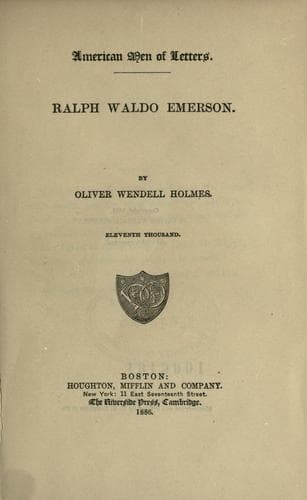
Authors, American -- 19th century -- Biography; Emerson, Ralph Waldo, 1803-1882
"A Brother of the world, his song
Sounded like a tempest strong
Which tore from oaks their branches broad,
And stars from the ecliptic road.
Time wore he as his clothing-weeds,
He sowed the sun and moon for seeds.
As melts the iceberg in the seas,
As clouds give rain to the eastern breeze,
As snow-banks thaw in April's beam,
The solid kingdoms like a dream
Resist in vain his motive strain,
They totter now and float amain.
For the Muse gave special charge
His learning should be deep and large,
And his training should not scant
The deepest lore of wealth or want:
His flesh should feel, his eyes should read
Every maxim of dreadful Need;
In its fulness he should taste
Life's honeycomb, but not too fast;
Full fed, but not intoxicated;
He should be loved; he should be hated;
A blooming child to children dear,
His heart should palpitate with fear."
We look naturally to see what poets were Emerson's chief favorites. In
his poems "The Test" and "The Solution," we find that the five whom
he recognizes as defying the powers of destruction are Homer, Dante,
Shakespeare, Swedenborg, Goethe.
Here are a few of his poetical characterizations from "The Harp:"--
"And this at least I dare affirm,
Since genius too has bound and term,
There is no bard in all the choir,
Not Homer's self, the poet-sire,
Wise Milton's odes of pensive pleasure,
Or Shakespeare whom no mind can measure,
Nor Collins' verse of tender pain,
Nor Byron's clarion of disdain,
Scott, the delight of generous boys,
Or Wordsworth, Pan's recording voice,--
Not one of all can put in verse,
Or to this presence could rehearse
The sights and voices ravishing
The boy knew on the hills in spring."--
In the notice of "Parnassus" some of his preferences have been already
mentioned.
Comparisons between men of genius for the sake of aggrandizing the
one at the expense of the other are the staple of the meaner kinds of
criticism. No lover of art will clash a Venetian goblet against a Roman
amphora to see which is strongest; no lover of nature undervalues a
violet because it is not a rose. But comparisons used in the way of
description are not odious.
Public-domain text, read in full here on John Shaqi.
Reviews
Reviews
No reviews yet
Be the first to share your thoughts on this work.
Elsewhere in the archive
Join the Discussion
Join the discussion
Sign in to leave a comment or review.
Sign InorCreate an account