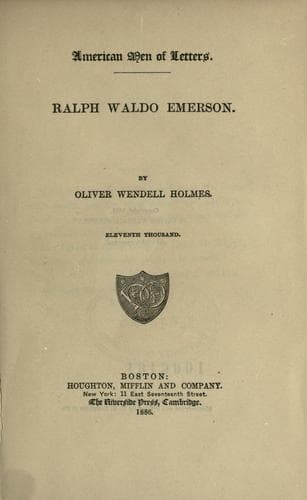
Authors, American -- 19th century -- Biography; Emerson, Ralph Waldo, 1803-1882
"His harp is silent: shall successors rise,
Touching with venturous hand the trembling string,
Kindle glad raptures, visions of surprise,
And wake to ecstasy each slumbering thing?
Shall life and thought flash new in wondering eyes,
As when the seer transcendent, sweet, and wise,
World-wide his native melodies did sing,
Flushed with fair hopes and ancient memories?
Ah, no! That matchless lyre shall silent lie:
None hath the vanished minstrel's wondrous skill
To touch that instrument with art and will.
With him, winged poesy doth droop and die;
While our dull age, left voiceless, must lament
The bard high heaven had for its service sent."
"Over an hour was occupied by the passing files of neighbors,
friends, and visitors looking for the last time upon the face of the
dead poet. The body was robed completely in white, and the face bore
a natural and peaceful expression. From the church the procession
took its way to the cemetery. The grave was made beneath a tall
pine-tree upon the hill-top of Sleepy Hollow, where lie the bodies
of his friends Thoreau and Hawthorne, the upturned sod being
concealed by strewings of pine boughs. A border of hemlock spray
surrounded the grave and completely lined its sides. The services
here were very brief, and the casket was soon lowered to its final
resting-place.
"The Rev. Dr. Haskins, a cousin of the family, an Episcopal
clergyman, read the Episcopal Burial Service, and closed with the
Lord's Prayer, ending at the words, 'and deliver us from evil.'
In this all the people joined. Dr. Haskins then pronounced the
benediction. After it was over the grandchildren passed the open
grave and threw flowers into it."
So vanished from human eyes the bodily presence of Ralph Waldo Emerson,
and his finished record belongs henceforth to memory.
CHAPTER XVI.
EMERSON.--A RETROSPECT.
Personality and Habits of Life.--His Commission and Errand.--As a
Lecturer.--His Use of Authorities.--Resemblance to Other Writers.--As
influenced by Others.--His Place as a Thinker.--Idealism and
Intuition.--Mysticism.--His Attitude respecting Science.--As an
American.--His Fondness for Solitary Study.--His Patience and
Amiability.--Feeling with which he was regarded.--Emerson and
Burns.--His Religious Belief.--His Relations with Clergymen.--Future of
his Reputation.--His Life judged by the Ideal Standard.
Public-domain text, read in full here on John Shaqi.
Reviews
Reviews
No reviews yet
Be the first to share your thoughts on this work.
Elsewhere in the archive
Join the Discussion
Join the discussion
Sign in to leave a comment or review.
Sign InorCreate an account