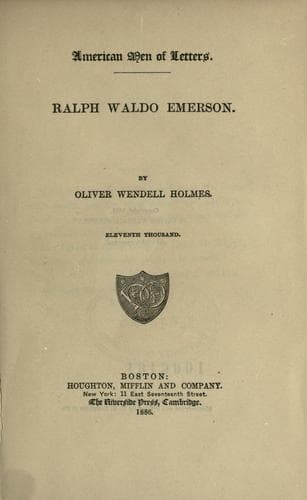
Authors, American -- 19th century -- Biography; Emerson, Ralph Waldo, 1803-1882
In an unpublished manuscript kindly submitted to me by Mr. Frothingham,
Emerson is reported as saying, "God has given me the seeing eye, but not
the working hand." His gift was insight: he saw the germ through its
envelop; the particular in the light of the universal; the fact in
connection with the principle; the phenomenon as related to the law; all
this not by the slow and sure process of science, but by the sudden
and searching flashes of imaginative double vision. He had neither the
patience nor the method of the inductive reasoner; he passed from one
thought to another not by logical steps but by airy flights, which left
no footprints. This mode of intellectual action when found united with
natural sagacity becomes poetry, philosophy, wisdom, or prophecy in its
various forms of manifestation. Without that gift of natural sagacity
(_odoratio quaedam venatica_),--a good scent for truth and beauty,--it
appears as extravagance, whimsicality, eccentricity, or insanity,
according to its degree of aberration. Emerson was eminently sane for
an idealist. He carried the same sagacity into the ideal world that
Franklin showed in the affairs of common life.
He was constitutionally fastidious, and had to school himself to become
able to put up with the terrible inflictions of uncongenial fellowships.
We must go to his poems to get at his weaknesses. The clown of the first
edition of "Monadnoc" "with heart of cat and eyes of bug," disappears
in the after-thought of the later version of the poem, but the eye that
recognized him and the nature that recoiled from him were there still.
What must he not have endured from the persecutions of small-minded
worshippers who fastened upon him for the interminable period between
the incoming and the outgoing railroad train! He was a model of patience
and good temper. We might have feared that he lacked the sensibility to
make such intrusions and offences an annoyance. But when Mr. Frothingham
gratifies the public with those most interesting personal recollections
which I have had the privilege of looking over, it will be seen that his
equanimity, admirable as it was, was not incapable of being disturbed,
and that on rare occasions he could give way to the feeling which showed
itself of old in the doom pronounced on the barren fig-tree.
Public-domain text, read in full here on John Shaqi.
Reviews
Reviews
No reviews yet
Be the first to share your thoughts on this work.
Elsewhere in the archive
Join the Discussion
Join the discussion
Sign in to leave a comment or review.
Sign InorCreate an account