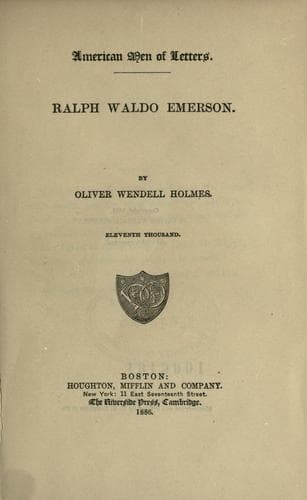
Authors, American -- 19th century -- Biography; Emerson, Ralph Waldo, 1803-1882
Now and then, but not with any questionable frequency, we find a
sentence which recalls Carlyle.
"The national temper, in the civil history, is not flashy or whiffling.
The slow, deep English mass smoulders with fire, which at last sets all
its borders in flame. The wrath of London is not French wrath, but has a
long memory, and in hottest heat a register and rule."
Compare this passage from "English Traits" with the following one from
Carlyle's "French Revolution":--
"So long this Gallic fire, through its successive changes of color and
character, will blaze over the face of Europe, and afflict and scorch
all men:--till it provoke all men, till it kindle another kind of fire,
the Teutonic kind, namely; and be swallowed up, so to speak, in a day!
For there is a fire comparable to the burning of dry jungle and grass;
most sudden, high-blazing: and another fire which we liken to the
burning of coal, or even of anthracite coal, but which no known thing
will put out."
"O what are heroes, prophets, men
But pipes through which the breath of man doth blow
A momentary music."
The reader will find a similar image in one of Burns's letters, again in
one of Coleridge's poetical fragments, and long before any of them, in a
letter of Leibnitz.
"He builded better than he knew"
is the most frequently quoted line of Emerson. The thought is constantly
recurring in our literature. It helps out the minister's sermon; and a
Fourth of July Oration which does not borrow it is like the "Address
without a Phoenix" among the Drury Lane mock poems. Can we find any
trace of this idea elsewhere?
In a little poem of Coleridge's, "William Tell," are these two lines:
"On wind and wave the boy would toss
Was great, nor knew how great he was."
The thought is fully worked out in the celebrated Essay of Carlyle
called "Characteristics." It reappears in Emerson's poem "Fate."
"Unknown to Cromwell as to me
Was Cromwell's measure and degree;
Unknown to him as to his horse,
If he than his groom is better or worse."
It is unnecessary to illustrate this point any further in this
connection. In dealing with his poetry other resemblances will suggest
themselves. All the best poetry the world has known is full of such
resemblances. If we find Emerson's wonderful picture, "Initial Love"
prefigured in the "Symposium" of Plato, we have only to look in the
"Phaedrus" and we we shall find an earlier sketch of Shakespeare's
famous group,--
"The lunatic, the lover, and the poet."
Public-domain text, read in full here on John Shaqi.
Reviews
Reviews
No reviews yet
Be the first to share your thoughts on this work.
Elsewhere in the archive
Join the Discussion
Join the discussion
Sign in to leave a comment or review.
Sign InorCreate an account