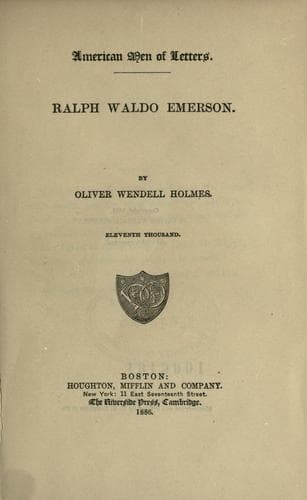
Authors, American -- 19th century -- Biography; Emerson, Ralph Waldo, 1803-1882
It seems to us, to-day, that Emerson's best literary work in prose and
verse must live as long as the language lasts; but whether it live or
fade from memory, the influence of his great and noble life and
the spoken and written words which were its exponents, blends,
indestructible, with the enduring elements of civilization.
* * * * *
It is not irreverent, but eminently fitting, to compare any singularly
pure and virtuous life with that of the great exemplar in whose
footsteps Christendom professes to follow. The time was when the divine
authority of his gospel rested chiefly upon the miracles he is reported
to have wrought. As the faith in these exceptions to the general laws
of the universe diminished, the teachings of the Master, of whom it was
said that he spoke as never man spoke, were more largely relied upon
as evidence of his divine mission. Now, when a comparison of these
teachings with those of other religious leaders is thought by many to
have somewhat lessened the force of this argument, the life of the
sinless and self-devoted servant of God and friend of man is appealed to
as the last and convincing proof that he was an immediate manifestation
of the Divinity.
Judged by his life Emerson comes very near our best ideal of humanity.
He was born too late for the trial of the cross or the stake, or even
the jail. But the penalty of having an opinion of his own and expressing
it was a serious one, and he accepted it as cheerfully as any of Queen
Mary's martyrs accepted his fiery baptism. His faith was too large and
too deep for the formulae he found built into the pulpit, and he was too
honest to cover up his doubts under the flowing vestments of a sacred
calling. His writings, whether in prose or verse, are worthy of
admiration, but his manhood was the underlying quality which gave them
their true value. It was in virtue of this that his rare genius acted on
so many minds as a trumpet call to awaken them to the meaning and the
privileges of this earthly existence with all its infinite promise.
No matter of what he wrote or spoke, his words, his tones, his looks,
carried the evidence of a sincerity which pervaded them all and was to
his eloquence and poetry like the water of crystallization; without
which they would effloresce into mere rhetoric. He shaped an ideal for
the commonest life, he proposed an object to the humblest seeker after
truth. Look for beauty in the world around you, he said, and you shall
see it everywhere. Look within, with pure eyes and simple trust, and you
shall find the Deity mirrored in your own soul. Trust yourself because
you trust the voice of God in your inmost consciousness.
Public-domain text, read in full here on John Shaqi.
Reviews
Reviews
No reviews yet
Be the first to share your thoughts on this work.
Elsewhere in the archive
Join the Discussion
Join the discussion
Sign in to leave a comment or review.
Sign InorCreate an account