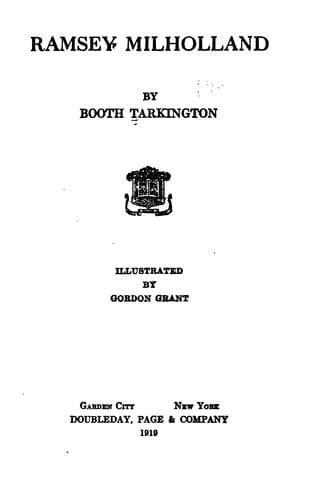
American fiction -- 20th century; Bildungsromans; World War, 1914-1918 -- United States -- Fiction; Young men -- Fiction
“It's all over college. She got up in the class in jurisprudence and
made a speech. It's a big class, you know, over two hundred, under Dean
Burney. He's a great lecturer, but he's a pacifist--the only one on the
faculty--and a friend of Dora's. They say he encouraged her to make this
break and led the subject around so she could do it, and then called on
her for an opinion, as the highest-stand student in the class. She got up
and claimed there wasn't any such thing as a legitimate cause for war,
either legally or morally, and said it was a sign of weakness in a
nation for it to believe that it did have cause for war.
“Well, it was too much for that little, spunky Joe Stansbury, and he
jumped up and argued with her. He made her admit all the Germans have
done to us, the sea murders and the land murders, the blowing up of the
factories, the propaganda, the strikes, trying to turn the United States
into a German settlement, trying to get Japan and Mexico to make war on
us, and all the rest. He even made her admit there was proof they mean
to conquer us when they get through with the others, and that they've
set out to rule the world for their own benefit, and make whoever else
they kindly allow to live, to work for them.
“She said it might be true, but since nothing at all could be a right
cause for war, than all this couldn't be a cause of war. Of course she
had her regular pacifist 'logic' working; she said that since war is
the worst thing there is, why, all other evils were lesser, and a lesser
evil can't be a just cause for a greater. She got terribly excited,
they say, but kept right on, anyway. She said war was murder and there
couldn't be any other way to look at it; and she'd heard there was
already talk in the university of students thinking about enlisting,
and whoever did such a thing was virtually enlisting to return murder for
murder. Then Joe Stansbury asked her if she meant that she'd feel toward
any student that enlisted the way she would toward a murderer, and she
said, yes, she'd have a horror of any student that enlisted.
“Well, that broke up the class; Joe turned from her to the platform and
told old Burney that he was responsible for allowing such talk in his
lecture-room, and Joe said so far as _he_ was concerned, he resigned
from Burney's classes right there. That started it, and practically the
whole class got up and walked out with Joe. They said Burney streaked
off home, and Dora was left alone in there, with her head down on her
desk--and I guess she certainly deserves it. A good many have already
stopped speaking to her.”
Ramsey fidgeted with a pen on the table by which he sat. “Well, I don't
know,” he said, slowly; “I don't know if they ought to do that exactly.”
“Why oughtn't they?” Fred demanded, sharply.
Public-domain text, read in full here on John Shaqi.
Reviews
Reviews
No reviews yet
Be the first to share your thoughts on this work.
Elsewhere in the archive
Join the Discussion
Join the discussion
Sign in to leave a comment or review.
Sign InorCreate an account