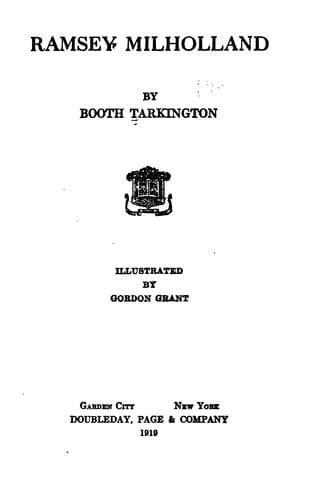
American fiction -- 20th century; Bildungsromans; World War, 1914-1918 -- United States -- Fiction; Young men -- Fiction
She went back to her room, shivering, and spent the next day in bed with
an aching head. She rose in the evening, however--a handbill had been
slid under her door at five o'clock, calling a “Mass Meeting” of the
university at eight, and she felt it her duty to go; but when she got to
the great hall she found a seat in the dimmest corner, farthest from the
rostrum.
The president of the university addressed the tumultuous many hundreds
before him, for tumultuous they were until he quieted them. He talked to
them soberly of patriotism, and called upon them for “deliberation and
a little patience.” There was danger of a stampede, he said, and he and
the rest of the faculty were in a measure responsible to their fathers
and mothers for them.
“You must keep your heads,” he said. “God knows, I do not seek to judge
your duty in this gravest moment of your lives, nor assume to tell you
what you must or must not do. But by hurrying into service now, without
careful thought or consideration, you may impair the extent of your
possible usefulness to the very cause you are so anxious to serve.
Hundreds of you are taking technical courses which should be
completed--at least to the end of the term in June. Instructors from the
United States Army are already on the way here, and military training
will be begun at once for all who are physically eligible and of
acceptable age. A special course will be given in preparation for
flying, and those who wish to become aviators may enroll themselves for
the course at once.
“I speak to you in a crisis of the university's life, as well as that of
the nation, and the warning I utter has been made necessary by what took
place yesterday and to-day. Yesterday morning, a student in the junior
class enlisted as a private in the United States Regular Army. Far be it
from me to deplore his course in so doing; he spoke to me about it, and
in such a way that I felt I had no right to dissuade him. I told him
that it would be preferable for college men to wait until they could
go as officers, and, aside from the fact of a greater prestige, I urged
that men of education could perhaps be more useful in that capacity. He
replied that if he were useful enough as a private a commission might in
time come his way, and, as I say, I did not feel at liberty to attempt
dissuasion. He left to join a regiment to which he had been assigned,
and many of you were at the station to bid him farewell.
“But enthusiasm may be too contagious; even a great and inspiring motive
may work for harm, and the university must not become a desert. In the
twenty-four hours since that young man went to join the army last night,
one hundred and eleven of our young men students have left our walls;
eighty-four of them went off together at three o'clock to catch an
east-bound train at the junction and enlist for the Navy at Newport. We
are, I say, in danger of a stampede.”
Public-domain text, read in full here on John Shaqi.
Reviews
Reviews
No reviews yet
Be the first to share your thoughts on this work.
Elsewhere in the archive
Join the Discussion
Join the discussion
Sign in to leave a comment or review.
Sign InorCreate an account