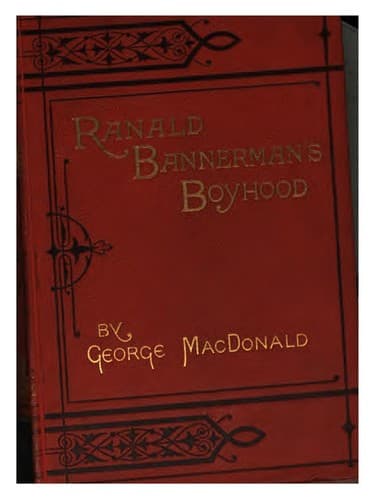
Brothers -- Juvenile fiction; Christian life -- Juvenile fiction; Country life -- Juvenile fiction; Scotland -- Juvenile fiction
During all that winter I attended the evening school and assisted the
master. I confess, however, it was not by any means so much for the
master as to be near Elsie Duff, of whom I now thought many times an
hour. Her sweet face grew more and more dear to me. When I pointed out
an error in her work, or suggested a better mode of working, it would
flush like the heart of a white rose, and eagerly she would set
herself to rectification or improvement, her whole manner a dumb
apology for what could be a fault in no eyes but her own. It was this
sweetness that gained upon me: at length her face was almost a part of
my consciousness. I suppose my condition was what people would call
being in love with her; but I never thought of that; I only thought of
her. Nor did I ever dream of saying a word to her on the subject. I
wished nothing other than as it was. To think about her all day, so
gently that it never disturbed Euclid or Livy; to see her at night,
and get near her now and then, sitting on the same form with her as I
explained something to her on the slate or in her book; to hear her
voice, and look into her tender eyes, was all that I desired. It never
occurred to me that things could not go on so; that a change must
come; that as life cannot linger in the bud, but is compelled by the
sunshine and air into the flower, so life would go on and on, and
things would change, and the time blossom into something else, and my
love find itself set out-of-doors in the midst of strange plants and a
new order of things.
When school was over, I walked home with her--not alone, for Turkey
was always on the other side. I had not a suspicion that Turkey’s
admiration of Elsie could ever come into collision with mine. We
joined in praising her, but my admiration ever found more words than
Turkey’s, and I thought my love to her was greater than his.
We seldom went into her grandmother’s cottage, for she did not make us
welcome. After we had taken her home we generally repaired to Turkey’s
mother, with whom we were sure of a kind reception. She was a patient
diligent woman, who looked as if she had nearly done with life, and
had only to gather up the crumbs of it. I have often wondered since,
what was her deepest thought--whether she was content to be unhappy,
or whether she lived in hope of some blessedness beyond. It is
marvellous with how little happiness some people can get through the
world. Surely they are inwardly sustained with something even better
than joy.
“Did you ever hear my mother sing?” asked Turkey, as we sat together
over her little fire, on one of these occasions.
“No. I should like very much,” I answered.
The room was lighted only by a little oil-lamp, for there was no flame
to the fire of peats and dried oak-bark.
“She sings such queer ballads as you never heard,” said Turkey. “Give
us one, mother; do.”
She yielded, and, in a low chanting voice, sang something like this:--
Public-domain text, read in full here on John Shaqi.
Reviews
Reviews
No reviews yet
Be the first to share your thoughts on this work.
Elsewhere in the archive
Join the Discussion
Join the discussion
Sign in to leave a comment or review.
Sign InorCreate an account