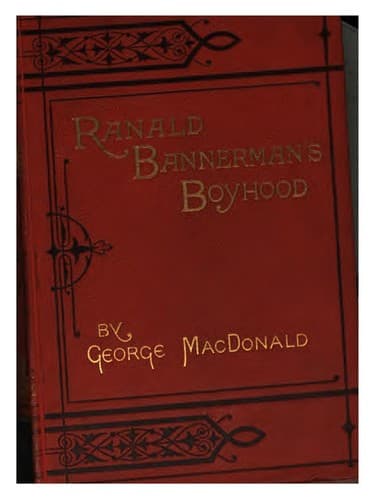
Brothers -- Juvenile fiction; Christian life -- Juvenile fiction; Country life -- Juvenile fiction; Scotland -- Juvenile fiction
“And when did it happen, said you?” asked one of them, whose head
moved with an incessant capricious motion from palsy.
“About two o’clock this morning,” answered the other, who leaned on a
stick, almost bent double with rheumatism. “I saw their next-door
neighbour this morning, and he had seen Jamie, who goes home of a
Saturday night, you know; but William being a Seceder, nobody’s been
to tell the minister, and I’m just waiting to let him know; for she
was a great favourite of his, and he’s been to see her often. They’re
much to be pitied--poor people! Nobody thought it would come so sudden
like. When I saw her mother last, there was no such notion in her
head.”
Before I could ask of whom they were talking, my father came up the
aisle from the vestry, and stopped to speak to the old women.
“Elsie Duff’s gone, poor thing!” said the rheumatic one.
I grew stupid. What followed I have forgotten. A sound was in my ears,
and my body seemed to believe it, though my soul could not comprehend
it. When I came to myself I was alone in the church. They had gone
away without seeing me. I was standing beside the monument, leaning on
the carved Crusader. The sun was again shining, and the old church was
full of light. But the sunshine had changed to me, and I felt very
mournful. I should see the sweet face, hear the lovely voice, no more
in this world. I endeavoured to realize the thought, but could not,
and I left the church hardly conscious of anything but a dull sense of
loss.
I found my father very grave. He spoke tenderly of Elsie; but he did
not know how I had loved her, and I could not make much response. I
think, too, that he said less than he otherwise would, from the fear
of calling back to my mind too vivid a memory of how ill I had once
behaved to her. It was, indeed, my first thought the moment he uttered
her name, but it soon passed, for much had come between.
In the evening I went up to the farm to look for Turkey, who had not
been at church morning or afternoon. He was the only one I could talk
to about Elsie. I found him in one of the cow-houses, bedding the
cows. His back was towards me when I entered.
“Turkey,” I said.
He looked round with a slow mechanical motion, as if with a conscious
effort of the will. His face was so white, and wore such a look of
loss, that it almost terrified me like the presence of something
awful. I stood speechless. He looked at me for a moment, and then
came slowly up to me, and laid his hand on my shoulder.
“Ranald,” he said, “we were to have been married next year.”
Before the grief of the man, mighty in its silence, my whole being was
humbled. I knew my love was not so great as his. It grew in my eyes a
pale and feeble thing; and I felt worthless in the presence of her
dead, whom alive I had loved with peaceful gladness. Elsie belonged to
Turkey, and he had lost her, and his heart was breaking. I threw my
arms round him, and wept for him, not for myself. It was thus I ceased
to be a boy.
Public-domain text, read in full here on John Shaqi.
Reviews
Reviews
No reviews yet
Be the first to share your thoughts on this work.
Elsewhere in the archive
Join the Discussion
Join the discussion
Sign in to leave a comment or review.
Sign InorCreate an account