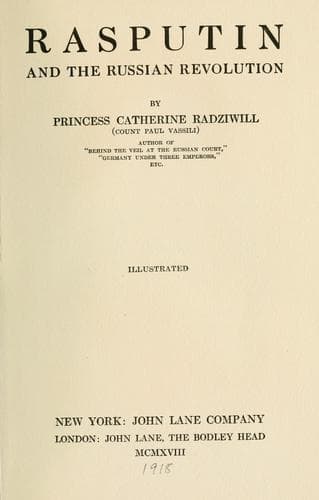
Rasputin and the Russian RevolutionRadziwill, Catherine, Princess
History
Rasputin and the Russian Revolution
Radziwill, Catherine, Princess
Rasputin, Grigorii Efimovich, 1869-1916; Soviet Union -- History -- Revolution, 1917-1921
With it all he was in some respects an intelligent man. He cared for
good reading, for arts, for music, for all the things which help to
make out of life a pleasant thing for irresponsible individuals. He was
fond of study, very painstaking, but ignorant, and doing all that was
required of him, in an almost automatic manner; kind, it is true, but
incapable of coming to any serious resolution or determination of his
own accord; devoid of political sense, occasionally most obstinate,
and, unfortunately for him as well as for his country and dynasty, he
had the misfortune in all the circumstances when a sacrifice of some
fraction of his Imperial prerogatives came into question, not to be
able to understand either his people or the times he was living in, and
to have no thought for anything else but the safety of his own family,
forgetting utterly that his country and its welfare ought to have come
before them.
When he resigned himself to grant that shadow of a constitution, the
advent of which was hailed with such enthusiasm by the whole of Russia,
he might still, had he liked, have regained some part at least, of
his lost popularity. His personal prestige, or rather that of the
position he stood in, was still so great among the nation, that it
would have felt gratitude toward him, for every favour he would have
chosen to confer upon it, if only he had not taken back all that he
had given, almost immediately after he had awarded it. It is quite
certain that the first Duma committed many errors, but it should have
been remembered that no human achievement can reach perfection at
once; and the excitement and effervescence that had followed upon the
opening of the first Russian Parliament ought to have been allowed to
cool down, and been given sufficient time to make an honest trial of
its rights and privileges. At the period I am referring to, and this
notwithstanding all that was said to the contrary, a revolution like
the one which took place the other day, would have been an impossible
thing, because the Sovereign could still rely upon the army, and it
would have been better for him had he always leant upon it rather than
upon the low crowd of state functionaries with which he was exclusively
surrounded and out of which his wife had picked her favourites. He
might have checked the then rising tide of radicalism with which he
found himself unable to cope later on, and in the strength of which he
was to remain to the end mistaken, because he dreaded it when it was
not dangerous, and imagined that he had subdued it, at the very moment
when it had become, thanks to his own errors, and to his own faults,
sufficiently strong to carry him away on its waves.
Public-domain text, read in full here on John Shaqi.
Reviews
Reviews
No reviews yet
Be the first to share your thoughts on this work.
Elsewhere in the archive
Join the Discussion
Join the discussion
Sign in to leave a comment or review.
Sign InorCreate an account