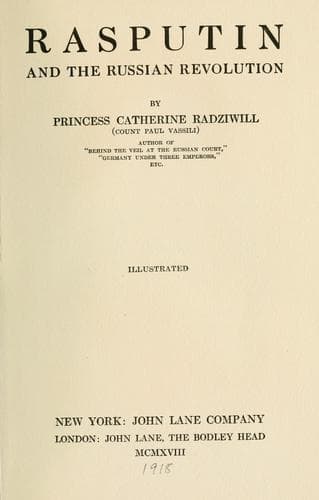
Rasputin and the Russian RevolutionRadziwill, Catherine, Princess
History
Rasputin and the Russian Revolution
Radziwill, Catherine, Princess
Rasputin, Grigorii Efimovich, 1869-1916; Soviet Union -- History -- Revolution, 1917-1921
Soon after this it was related that the Empress was in connivance
with the numerous people who had made it their business to plunder
the national exchequer, and that she looked with indulgence upon the
malversations from which profited the partisans and the accomplices,
for one could hardly call them by another name, of Rasputin. She began
to be hated even more ferociously than had been the case before, and
at last the police had to let Nicholas II. know that his Consort would
do better not to show herself too often in public, because an attempt
against her life might easily come to be made, under the influence of
all the stories which one heard right and left concerning her private
conduct and her affection for a being who was accused by the whole
nation of being fatal to Russia’s prosperity at home and good renown
abroad. The Czar listened to all this, as he was to listen later on to
the remonstrances of his own family, but he did not act on all that he
had been told. He continued to see Rasputin, partly because, according
to the tales of those who were in the secret of what really went on
in that strange Imperial household, the frank way of speaking of this
uncouth peasant amused him and pleased him, being something so totally
different from the language which he was accustomed to hear. But
contrary to what was generally believed, he did not discuss with him
matters of State, any more than did the Empress. It is to be hoped that
this last assertion is correct, and that Rasputin in regard to Nicholas
II. only played the part sustained by Chicot at the court of Henri III.
of France, that of the King’s Jester, capable occasionally of telling
some truths to his master. But during the last months which preceded
the removal of this sinister figure from the horizon of Tsarskoie Selo,
no one in Russia would believe in such a version, seeing that this
Jester could dispose according to his pleasure of all the high places
in the State, that he had created ministers, functionaries of paramount
importance, church dignitaries, and that whoever addressed himself to
him generally got what he wanted, whilst it was his friends who were
controlling the government of the vast empire of the Czars. One did not
realise that this had become possible only because all persons endowed
with the slightest independence of character, had gradually become
estranged from their Sovereign, and had come to the decision to abandon
him to his fate, disgusted as they were by his weakness in regard to
his wife, and being moreover unwilling to accept the responsibility
of duties which they were not allowed to fulfil according to the
dictates of their conscience. One after another the Ministers, who
at the beginning of the reign of Nicholas II. had helped him to rule
Russia, had been dismissed by him, or retired of their own accord,
and their places had been taken by simple subaltern functionaries,
preoccupied only with that one single thought of remaining as long as
Public-domain text, read in full here on John Shaqi.
Reviews
Reviews
No reviews yet
Be the first to share your thoughts on this work.
Elsewhere in the archive
Join the Discussion
Join the discussion
Sign in to leave a comment or review.
Sign InorCreate an account