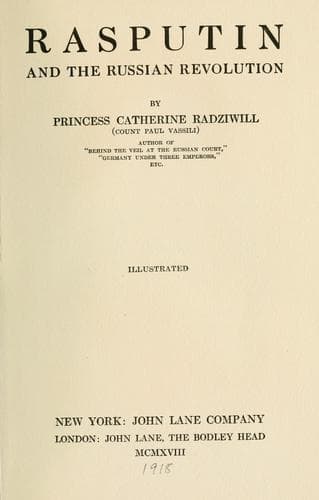
Rasputin and the Russian RevolutionRadziwill, Catherine, Princess
History
Rasputin and the Russian Revolution
Radziwill, Catherine, Princess
Rasputin, Grigorii Efimovich, 1869-1916; Soviet Union -- History -- Revolution, 1917-1921
As for the Emperor, he had ceased to count for anything in Russia,
after the failure of the so-called Constitutional government, which
he had inaugurated rather out of caprice than because he had become
convinced that it was indispensable to the welfare of Russia to see it
ruled by a responsible Cabinet. At the time I am referring to, it was
an acknowledged fact in the whole of Russia that it was governed by
some mysterious and dark powers which in secret were proceeding to any
amount of malversations, most harmful for the prosperity of the nation,
as well as for its prestige in Europe. The one general feeling which
prevailed everywhere was one of immense lassitude at a state of things
one knew but too well could not last, but which no one yet felt strong
enough to try to ameliorate, change, or overturn. If the war had not
broken out, it is likely that this condition, which hovered between
a dream and a nightmare, might have gone on for a long time, because
though the public realised perfectly well that the Throne, as well as
the man who occupied it, represented only a dead thing, yet it appeared
still so immense that no one dared to touch it, but continued looking
upon it, with the same eyes one would have done had it remained the
great one it had been formerly.
The war broke out and awakened the nation out of the state of marasm
into which it had fallen. During the first weeks which followed upon
its declaration there took place in Russia an explosion of enthusiasm
such as had never been witnessed before. It did not, however, last
any appreciable length of time, and collapsed together with the news
of the reverses that attended the Polish campaign. Nowhere were these
reverses felt more than amidst the ranks of the labour party, which,
as a direct consequence of them, acquired all at once an importance it
had hardly dared to hope it could win so soon. Factories became the
principal organ of the national defence, and the word “ammunition” was
transformed into the flag under which all those who were dissatisfied
with the government then in power enrolled themselves as well as the
people who longed for the end of an order of things the faults and
mistakes of which were known in Russia long before they came to be
recognised abroad. The workman suddenly became the individual to whom
was awarded the greatest importance, there where the question of the
salvation of the Fatherland came to be raised. He was the one to whom
everybody said aloud what he had been himself aware of long before,
that it was from him, and from his efforts, that depended victory over
the enemy who had audaciously invaded Russian territory. This workman
(this must never be lost sight of) was intimately connected with the
army in which he had served, with the army that had far more confidence
in him, and in his knowledge and efforts, than in the incapable
government that had sent it to be slaughtered without providing it
with any means to fight its foes.
Public-domain text, read in full here on John Shaqi.
Reviews
Reviews
No reviews yet
Be the first to share your thoughts on this work.
Elsewhere in the archive
Join the Discussion
Join the discussion
Sign in to leave a comment or review.
Sign InorCreate an account