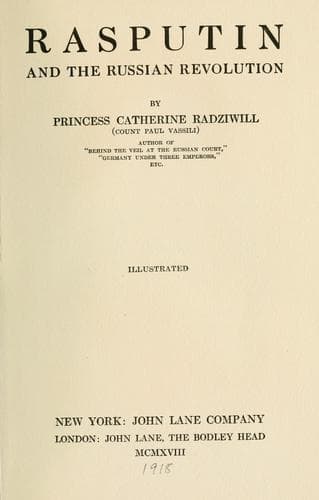
Rasputin and the Russian RevolutionRadziwill, Catherine, Princess
History
Rasputin and the Russian Revolution
Radziwill, Catherine, Princess
Rasputin, Grigorii Efimovich, 1869-1916; Soviet Union -- History -- Revolution, 1917-1921
On the 1st of November, 1916, one of the cousins of the Czar, the
Grand Duke Nicholas Michaylovitsch, who was perhaps the cleverest
member of the Imperial family, a man wonderfully well learned, and who
had acquired the reputation of an excellent historian, thanks to the
remarkable studies which he had published on the life and times of
Alexander I., and the Napoleonic wars, made another effort to shake
the influence of Rasputin, Protopopoff and the Empress. He asked the
Czar to receive him, and during a long and heated conversation which
he had with the latter, he read to him a letter which he had prepared
beforehand, in which were exposed not only the political, but also
the private reasons, which made it an imperative necessity to remove
Rasputin from Tsarskoie Selo. As the Grand Duke told his friends later
on, there were in this letter some passages that might have wounded
Nicholas II. in his feelings as a husband, not only as a sovereign. But
the Czar did not reply one single word, only went to fetch the Empress,
and in his turn read to her the incriminating epistle. When he reached
the passage in which remarks were made concerning her, Alexandra
Feodorovna rose up in a passion, and snatching the document out of
her husband’s hands, she tore it up into a thousand small pieces. In
the course of this memorable conversation, the Grand Duke asked the
Emperor whether he knew that the appointment of Protopopoff was the
work of Rasputin, with whom the former had become acquainted at the
house of one of their common friends, a certain Badmaieff.
“Yes,” replied the Czar, “I know it.”
“And you find this a matter of course,” exclaimed his cousin.
Nicholas II. replied nothing.
In spite of the angry tone which the discussion had assumed, the
Emperor remained perfectly civil to the Grand Duke. The latter
afterwards remarked that he had been more than surprised to meet
with such utter indifference, and at the same time such kindness, in
appearance at least, from his cousin. It seemed as if nothing that he
could say could move the Czar, who, during the most heated moments of
this interview, handed the matches to his kinsman, when he noticed
that the cigarette of the latter had gone out. At last the Grand Duke
exclaimed: “You have got Cossacks here, and a great deal of room in
your gardens. You can have me killed and buried without any one being
the wiser for it. But I must tell you the truth, and say to you that
you are going to your ruin.”
The Czar continued to be silent, and his cousin had to take his leave,
without having been able to obtain one single word from him by which he
might have guessed whether he had been believed or not.
Public-domain text, read in full here on John Shaqi.
Reviews
Reviews
No reviews yet
Be the first to share your thoughts on this work.
Elsewhere in the archive
Join the Discussion
Join the discussion
Sign in to leave a comment or review.
Sign InorCreate an account