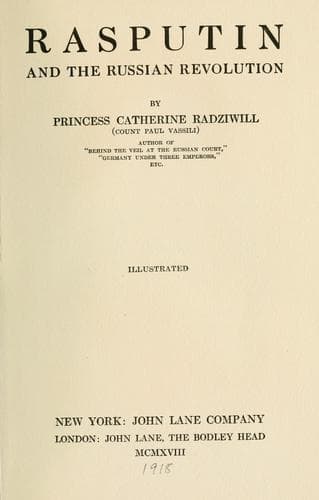
Rasputin and the Russian RevolutionRadziwill, Catherine, Princess
History
Rasputin and the Russian Revolution
Radziwill, Catherine, Princess
Rasputin, Grigorii Efimovich, 1869-1916; Soviet Union -- History -- Revolution, 1917-1921
This Assembly had met on the 27th of February, 1917, as had already
been settled before the resignation of Mr. Sturmer, and the appointment
of Prince Galitzyne as Prime Minister in his place. It became evident
from the very first day the Session was opened that most violent
discussions were about to take place, and that the government
would never be able to command a majority, because even the ultra
Conservatives who had backed it up before had forsaken it. One more
reason for discontent with it had arisen: the almost total lack of food
in Petrograd, where, thanks to the mismanagement of the railways and
the lack of tracks, no provisions of any kind could arrive. Riots of
a more or less serious character took place in different quarters of
the town; the population clamoured for bread, and broke the windows
in the bakers’ and butchers’ shops, wherever it could do so. This
was one more complication added to all those already existing. The
Duma thought it indispensable to make an energetic manifestation of
its want of confidence in the government’s power to grapple with the
difficulties of the situation. The parties composing the moderate left,
together with the Cadets that had recently united themselves into one
group denominated the “Bloc,” declared by the mouth of their leader,
Mr. Chidlovsky, that it was indispensable to call together a Cabinet
comprising really national elements, in possession of the confidence
of the country as well as that of the Sovereign, because the one in
existence was entirely discredited, even among its former supporters.
During the debates which followed upon this motion, the socialist
deputies, among others Mr. Tcheidze, expressed themselves in most
violent terms, and said, among other things, that the government then
in power would never understand the wishes or the needs of the nation,
or become reconciled with it, and that between it and the country there
existed an abyss which nothing in the world could ever fill. It had
against it the whole of Russia, and it had done nothing and was doing
nothing to smooth over the difficulties which it had itself created,
and for which it was alone responsible. And Mr. Tcheidze concluded his
speech by expressing his conviction that a compromise was no longer
possible, and that only a great national movement of revolt could
overturn the Cabinet and replace it by another one better able to
understand the needs of the country and of the army.
Public-domain text, read in full here on John Shaqi.
Reviews
Reviews
No reviews yet
Be the first to share your thoughts on this work.
Elsewhere in the archive
Join the Discussion
Join the discussion
Sign in to leave a comment or review.
Sign InorCreate an account