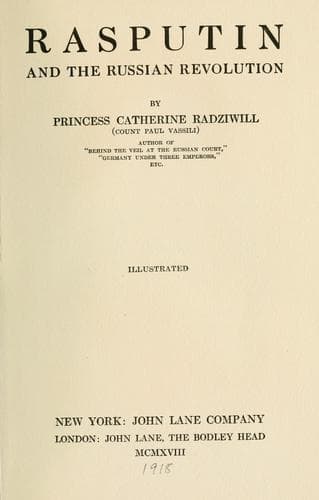
Rasputin and the Russian RevolutionRadziwill, Catherine, Princess
History
Rasputin and the Russian Revolution
Radziwill, Catherine, Princess
Rasputin, Grigorii Efimovich, 1869-1916; Soviet Union -- History -- Revolution, 1917-1921
abdication to the Delegates sent by the Duma to require it from him.
The unfortunate Monarch returned to Mohilew from Pskov on the 17th
of March. On the next day arrived there by special train his mother,
the Dowager Empress Marie, who, upon hearing of the misfortunes that
had befallen her son, had hastened to his side. Their relations had
been more than strained for a long time, thanks to the intrigues of
the Empress Alexandra, but in those moments of agony the mother’s
heart forgot aught else save that her child was in trouble, and she
rushed to him to try at least to help him by her presence to bear it.
Nicholas II. felt the nobility of this conduct, and the few days which
he spent with Marie Feodorovna did away with much of the bitterness
that had presided at their intercourse with each other for some time.
But what they must have been for the widowed Empress it would be hardly
possible to imagine. She understood but too well, if he did not, the
perils which awaited her son in the future, and the contrast which his
reign had presented with that of his father must have filled her soul
with agony and distress. Fate proved itself indeed hard for this noble
woman, because it inflicted upon her that last, supreme sorrow, of
seeing, before her train carried her back to this town of Kieff which
she had made her home for the last two years, Nicholas II. taken away a
captive to that palace that was to know him no longer for its master.
If one is to believe all that one hears, it seems that it was General
Alexieieff, together with General Roussky and a few socialist leaders,
who insisted on the provisional government ordering the arrest of the
former Czar and of his Consort. They represented to Mr. Miliukoff and
to his colleagues, that it would be the height of imprudence to allow
the Empress to remain at liberty and able to go on intriguing, as was
her wont, against the new administration. On the other hand sending the
Imperial family immediately abroad had also its inconveniences, because
their presence in Denmark or in England would only have been a cause of
embarrassment to the Allies. Then again, the hatred of the population
of Petrograd for Alexandra Feodorovna had reached such immense
proportions that it was feared it would give way to excesses against
her, and even attempts to murder her, if some kind of satisfaction
were not given to its incensed feelings in respect to a woman who was
considered everywhere in the light of the worst of traitors. For this
reason or for another, it is not quite clear, but most likely because
of the representations made by Roussky and by Alexieieff, the Executive
Committee of the Duma, which was then the highest authority in Russia,
decided to arrest Nicholas II. together with his Consort.
Public-domain text, read in full here on John Shaqi.
Reviews
Reviews
No reviews yet
Be the first to share your thoughts on this work.
Elsewhere in the archive
Join the Discussion
Join the discussion
Sign in to leave a comment or review.
Sign InorCreate an account