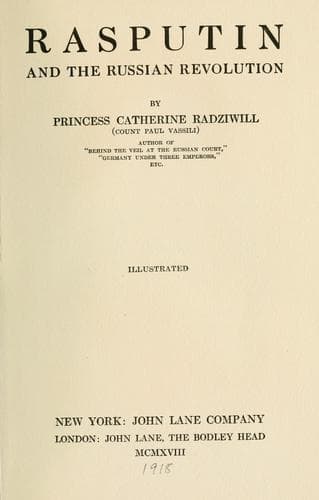
Rasputin and the Russian RevolutionRadziwill, Catherine, Princess
History
Rasputin and the Russian Revolution
Radziwill, Catherine, Princess
Rasputin, Grigorii Efimovich, 1869-1916; Soviet Union -- History -- Revolution, 1917-1921
I have given the narrative as it was related to me by people whose
veracity I have no reason to challenge. It is certain, however, that
many of its details are still unknown, and it is doubtful whether
they will be revealed before the end of the war. At present there are
too many persons interested in dissimulating the part which they have
played in the drama, either out of fear, or because they do not think
the time opportune. It seems sometimes as if there exists a tacit
understanding among the actors of the tragedy to hide the details of
the conspiracy which came to an end by the signature of the Manifest
of Pskov. This signature was wrenched, no one knows yet by just what
means, out of the weakness of Nicholas II!--that unfortunate Monarch
who has never realised the obligations and duties he owed to the
nation that dethroned him. The last crowned Romanoff had never had,
unfortunately for him, and still more unfortunately for his subjects,
a sense of appreciation of the real value of facts or of events, which
sometimes is even more useful than a great intelligence, to those whom
destiny has entrusted with the difficult task of ruling over nations.
He believed that his duty consisted in upholding the superannuated
traditions of autocracy, and he did not perceive that these traditions
had been maintained so long only because there had existed strong men
to enforce them. Honest and kind of heart though he was, at least in
many respects, he had contrived in spite of these qualities to rouse
against him from the very first days of his accession to the Throne all
the social classes of his country. He had irritated the aristocracy,
wounded the feelings of the army and of the people, and excited against
himself the passions of the proletariat and of the peasantry, by his
weakness of character and his obstinacy in surrounding himself with
the most hated and most despised elements in Russia. A few days before
his fall he might still have made a successful effort to save himself
and his dynasty, had he only followed the disinterested advice which
was forwarded to him by his Allies and consented to the establishment
of a responsible Ministry. He preferred to listen to his wife and
to the people she kept around her. Instead of trying to conciliate
his subjects, he threatened them, until the expected occurred, and
he lost not only his crown but also his liberty; and has perhaps
forfeited his life and that of his family.
But the future, the future, my readers will ask me, What will be the
future, what shall it bring forth for Russia? The only reply possible
to this eager question is to quote the words of Victor Hugo in his
wonderful Ode to Napoleon: “The future belongs to no one, it is
controlled by God alone.”
[Illustration:
_Copyright, 1918, International Film Service, Inc._
THE HOUSE AT BREST-LITOVSK WHERE PEACE NEGOTIATIONS BETWEEN THE RUSSIAN
BOLSHEVIKI AND THE AUSTRO-GERMANS WERE CONDUCTED]
Transcriber’s Notes
Public-domain text, read in full here on John Shaqi.
Reviews
Reviews
No reviews yet
Be the first to share your thoughts on this work.
Elsewhere in the archive
Join the Discussion
Join the discussion
Sign in to leave a comment or review.
Sign InorCreate an account