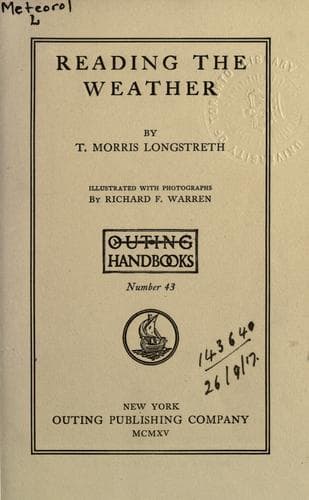
Reading the WeatherLongstreth, T. Morris (Thomas Morris)
Science
Reading the Weather
Longstreth, T. Morris (Thomas Morris)
Weather forecasting
While scarcely a year goes by without one of these West Indian hurricanes
distinguishing itself on our shores the one that visited Galveston in 1904
eclipsed all. It chose to turn in the vicinity of the city. The gale
increased to over 100 miles an hour and the wind gauge then blew away. The
waters of the Bay were heaped up and three thousand lives were lost in the
flood and wreck of flying houses. This peculiar storm did not turn
northeast at once but ascended the Mississippi, turning at the Lakes and
proceeding down the St. Lawrence after having spent a week in our country.
The listless doldrums have sent us 121 of these storms in the last
generation. June has seen 8, July 5, August 28, September 40, and October
40.
Sea-yarners have seized upon the hurricane to energize many a flagging
chapter, and particularly have they emphasized the eye of the storm. The
eye is that vortex where contending winds neutralize each other into a
calm, where the sun shines out through the scud, where the waves, relieved
of the great pressure, leap upward in wild disorder. Then the center
passes and the wind flings itself upon the unlucky bark from the opposite
quarter. Its first onslaught is always represented as being the fiercest
of the whole storm and gradually lessening as the center drives farther
away. This is true in the same way that the first attack of the
thunderstorm is usually the fiercest, both being when the pressure begins
to rise. This savage change to the northwest is naturally the hardest of
all for the ships to bear as they must steady at once against the severest
blast instead of gradually bracing for its culmination. In no department
of meteorology has fiction adhered so closely to the facts as in the
sea-rover accounts of the hurricane.
But in real life there is very little excuse for the vessel to be caught
anywhere near the disastrous center of the storm. Indeed, for generations
sea-captains have known how to escape the deadly eye. By watching the
barometer and noticing in which direction the wind is working round they
can tell the course to a nicety and estimate its speed. Then the wise
ones run the other way for even the _Olympics_ and _Imperators_ of the sea
are cowed by the might of the West Indian.
The typhoons of the West Pacific are similar manifestations.
The hurricane moves off from its birthplace so slowly that our Weather
Bureau has an opportunity to size it up, to chart its probable course, and
to warn shipping interests. The ship-owners, as a class, appreciate the
service of the Bureau and obey its warnings. Vessels with cargoes of a
total value of $30,000,000 were known to have been detained in port on the
Atlantic coast by the Bureau's warnings of a single hurricane. Now that a
much vaster commerce will steam through these dangerous waters toward the
Panama Canal the warnings will assume an even greater importance.
Public-domain text, read in full here on John Shaqi.
Reviews
Reviews
No reviews yet
Be the first to share your thoughts on this work.
Elsewhere in the archive
Join the Discussion
Join the discussion
Sign in to leave a comment or review.
Sign InorCreate an account