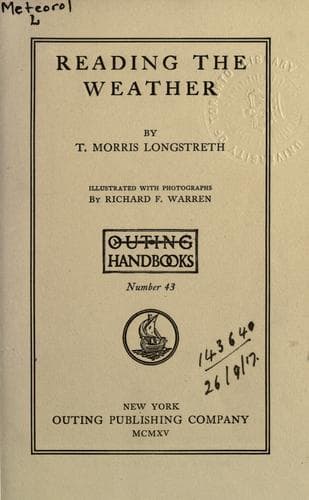
Reading the WeatherLongstreth, T. Morris (Thomas Morris)
Science
Reading the Weather
Longstreth, T. Morris (Thomas Morris)
Weather forecasting
The best description of a hurricane that it has been my fortune to read is
in a story entitled "Chita," one of the remarkable fictions of Lafcadio
Hearn. As truthfully as a scientist and with great beauty of style he has
pictured the long days of burning sun, the foreboding calm, the thickening
haze, the ominous increasing swell of the ocean, a breathless night with
the lightning glowing from between piling towers of cloud, the startling
suddenness of the wind's attack, its fury, the hissing rain, the shrill
crescendo of the gale.
CLOUDBURST
It is the American tendency to exaggerate. We call every snowstorm a
blizzard, every breeze a gale, every shower a cloudburst. In our generous
vocabulary it never rains but it pours. Consequently if we, in the East,
ever had a real blizzard or a real cloudburst we should be at a
considerable loss to find words for an unprofane description. I do not
know how they manage out West where these things occur.
A genuine cloudburst must be an amazing spectacle. It is caused by a
furious updraft of wind keeping a rainstorm in suspense until so much
water has accumulated that it has to let go all at once and the
accumulation descends like a wet blanket.
This phenomenon is staged in the mountains; most often in the Rockies
where melting snow and desert-hot ravines provide the necessary extremes
of temperature. Wind blowing up a mountain-side can maintain considerable
force,--so much that a man cannot possibly walk against it. Black thunder
clouds brew on the peaks. Suddenly the collapse, and the person who tells
the story afterward finds himself struggling in a torrent that a minute
before had been a dry gulch. The moral of the story seems to be that if
you are camping in the mountains and there is a strong upstream wind
blowing and the clouds darken about the hill-tops and the thunder mumbles
then don't make your bed in the creek-bottom lands. The high water marks
of former freshets, but not of cloudbursts, show on the side of the
stream.
Even in the less impulsive East a couple of inches of rain make a
surprising rise in a little creek.
THE HALO
The halo is a luminous circle around the moon or the sun. It is caused by
the refraction of light passing through moisture, which at the usual
height is in the form of ice-crystals. The halo when complete consists of
two large circles whose diameters are constant, 45 and 92 degrees. Then
there are often other arches in contact. At each point of contact occurs a
parhelion which is a mock sun of brilliant colors and called a sun-dog.
Since the sun-dog is brighter than the other parts of the halo it
sometimes appears when the rest of the halo cannot be seen. Sun-dogs hunt
in pairs or fours. If the halo is colored the red is on the inside. When
the colors are caused by diffraction instead of refraction, the red is on
the outside of the prismatic ring and the halo is called a corona.
Public-domain text, read in full here on John Shaqi.
Reviews
Reviews
No reviews yet
Be the first to share your thoughts on this work.
Elsewhere in the archive
Join the Discussion
Join the discussion
Sign in to leave a comment or review.
Sign InorCreate an account