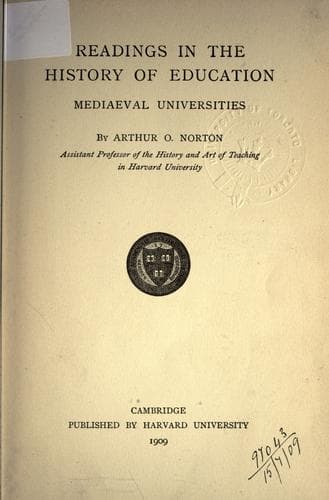
Readings in the History of Education: Mediaeval UniversitiesNorton, Arthur O.
History
Readings in the History of Education: Mediaeval Universities
Norton, Arthur O.
Education, Medieval -- History -- Sources; Universities and colleges -- Europe
Yet, though smiling [at these things], you have said truly that
where pleasure of the body is greater and fuller, there is the
exile of the soul; and where luxury reigns there the soul is a
wretched and afflicted hand-maid. O Paris! How well-suited art
thou to captivate and deceive souls! In thee are the nets of the
vices, in thee the arrow of Hell transfixes the hearts of the
foolish! This my John has felt and therefore he has named it an
exile. Would that you were leaving behind that exile of yours
just as it is, and were hastening to your native land not in word
and tongue only but in very deed and truth! There, in the book of
life would you be looking, not upon forms and elements, but upon
divinity itself, as it really is, as upon truth--eye to eye,
without labor of reading, without tediousness of seeing, without
fallacies and mistakes of understanding, without anxiety of
retaining, without fear of forgetting. O blessed school, where
Christ teaches our hearts with the words of his virtue, where
without study and lecture we learn how we should live happily to
eternity! There no book is bought, no teacher of things written
is hired, there is no circumventing in debate, no intricacy of
sophisms, [but] a plain settlement of all questions, a full
apprehension of universal reasons and arguments. There life
avails more than lecture; simplicity, more than cavilling. There
no one is shut in [i.e., limited in freedom] save he who is shut
out. In a word; there every reproach is done away with in the
answer given to him who evilly presents an evil life: "Depart
from me, ye cursed, into everlasting fire prepared for the devil
and his angels;" and to him who sets for a good life: "Come, ye
blessed" &c.
Would that the sons of men were as intent upon these better
studies as they are on idle talking, on vain and base buffoonery!
Certainly they would harvest richer fruits, more excellent
favors, certainly greater honors and beyond doubt would learn the
end of all perfection,--Christ,--whom they will never find in
these. Farewell.[78]
(c) _Letters from or to Students at Paris_
These letters belong to a period covering nearly four centuries. The
first gives an opinion of William of Champeaux in marked contrast to
that of Abelard.
(1) A CERTAIN D. WRITES TO A CERTAIN PRIOR CONCERNING HIS STUDIES AT
PARIS. (1109-1112.)
I am now in Paris in the School of Master William of Champeaux,
the greatest of all the men of his time whom I have known, in
every branch of learning. When we hear his voice we think that no
man, but, as it were, an angel from heaven, is speaking; for the
melody of his words and the profundity of his ideas transcends,
as it were, human limitations....
Public-domain text, read in full here on John Shaqi.
Reviews
Reviews
No reviews yet
Be the first to share your thoughts on this work.
Elsewhere in the archive
Join the Discussion
Join the discussion
Sign in to leave a comment or review.
Sign InorCreate an account