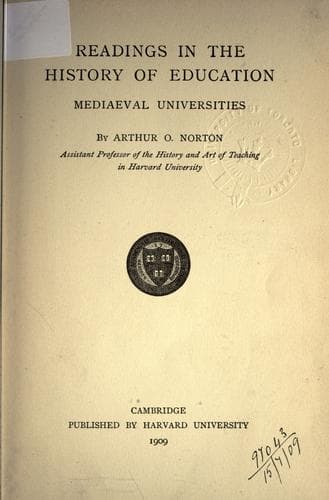
Readings in the History of Education: Mediaeval UniversitiesNorton, Arthur O.
History
Readings in the History of Education: Mediaeval Universities
Norton, Arthur O.
Education, Medieval -- History -- Sources; Universities and colleges -- Europe
For here (says the writer sarcastically) are distinguished
doctors of many faculties, some of whom by their crazy ways of
thinking, and still others by crazy ways of acting, others,
indeed, by inflicting wounds, and still others by abusive words,
furnish enjoyment that is exceeding pleasing; and (he adds more
seriously) there are other Masters subtly trained in the seven
liberal Arts, by whose example and teaching the entire earth,
like the heavens, is adorned with stars; and some of these
masters are illuminated by the three trivials and some by the
four quadrivials and some by both the trivials and the
quadrivials.
Now the three trivials are grammar, which teaches clearly the
agreement of speech; and starting from that, the youth who holds
on to his first teaching makes a beginning whereby he may obtain
a deeper taste of the profundities of other knowledge also; the
second is rhetoric, which by the charm of its colors adorns as
with pearls the subject matter, and ennobles grammar, and instils
acceptably into the ears of men that which is heard; the third is
logic by means of which the method of skilful deductive reasoning
is assigned to the individual sciences, without which the powers
of all the sciences are quiescent, and by whose addition all the
sciences are regularly organized. (The letter ends with a similar
description of the quadrivials.)[82]
2. TWO OXFORD LETTERS OF THE FIFTEENTH CENTURY
(1) OXFORD UNIVERSITY TO THE DUKE OF GLOUCESTER, ACKNOWLEDGING A GIFT OF
BOOKS. (1439.)
Most illustrious, most cultured and magnificent Prince, the
enduring value of the benefits you have conferred on the English
nation, and the meritorious deeds of your most powerful Highness
in its behalf can never die, but, with distinguished fame
destined to endure, will flourish with ever-renewed praise and
happy remembrance. How delightful it certainly is for us to
reflect upon these again and again! Among the rest, however, that
deed itself redounds to the splendor of your most mighty
Highness, namely, that after having brought about the repression
of heretic plotting against the church of God, you have chosen to
reinvigorate the vineyard of the Lord, your hand-maid, the
University of Oxford, with books on all the sciences and virtues,
out of which the abundant wine of knowledge and truth may be
squeezed by the press of study. For this reason we set forth in
this humble letter our thanks, our praise, and our prayers, but
we cannot express ourselves adequately.
Public-domain text, read in full here on John Shaqi.
Reviews
Reviews
No reviews yet
Be the first to share your thoughts on this work.
Elsewhere in the archive
Join the Discussion
Join the discussion
Sign in to leave a comment or review.
Sign InorCreate an account