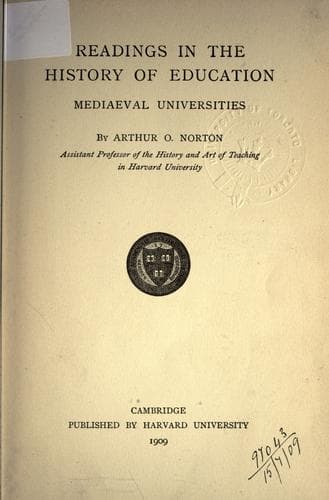
Readings in the History of Education: Mediaeval UniversitiesNorton, Arthur O.
History
Readings in the History of Education: Mediaeval Universities
Norton, Arthur O.
Education, Medieval -- History -- Sources; Universities and colleges -- Europe
These centuries include the second period of their academic history.
Their authority is now hardly questioned; and woe to the questioner!
They furnish the basis for the great structure of scholastic philosophy;
they are reconciled with Christian doctrine. Aristotle is thenceforward
"The Philosopher"--he is so styled even in modern scholastic philosophy;
he is "the forerunner of Christ in things natural," "the master of those
who know." In this period, then, academic debate concerned itself with
matters of detail. What portions of his works should be studied for the
various degrees in Arts? In what order should they be studied? What
comments should be read? What translations should be used? So late as
1519 these are the chief questions considered in the reformed plan of
studies in Arts at Leipzig. The reader will note the stress laid upon
the study of the text itself; the exclusion of frivolous comments, and
the use of the latest translations by Greek scholars.
Inasmuch as no good thing is more desirable than philosophy, as
Cicero says, and none more advantageous has been given to the
race of mortals, or granted by heaven, or will ever be given as a
gift; in order that we may possess this too, we choose as our
guide Aristotle, whom we cause to be commended for his knowledge
of facts, the number of his works, his ability in speaking, and
the acumen of his intellectual powers. Nor will we interpret the
visions and involved questions of his interpreters, since it is
characteristic of a very poor intellect to grow wise from
commentaries only, in which, neglecting Aristotle's meaning, the
Sophists dispute about empty trifles. But his works, translated
in part by Archeropylus [Argyropulos], in part by Augustus Nipho
and Hermolaus Barbarus and Theodoras Gaza, will be made clear in
the order outlined below:[24] [Then follows the list of books,
for which see p. 134].
The third stage of the debate concerning Aristotle began shortly after
1500. His works were less exclusively the subject of study: they were
being displaced by the Latin and Greek classics. They were, moreover,
the object of repeated attack. In 1536, in the University of Paris,
which had so long maintained their study, Pierre Ramus successfully
defended the startling thesis, "Everything that Aristotle taught is
false." This was only one sign of their loss of prestige. New and
improved text-books in Logic absorbed the useful portions of the
Organon; the authority of the Natural Philosophy waned with the rise of
experimental science; that of the Metaphysics yielded to the new
philosophy of Descartes. By the end of the seventeenth century they
ceased to be a potent factor in university studies.
(b) _The Roman Law_
Public-domain text, read in full here on John Shaqi.
Reviews
Reviews
No reviews yet
Be the first to share your thoughts on this work.
Join the Discussion
Join the discussion
Sign in to leave a comment or review.
Sign InorCreate an account