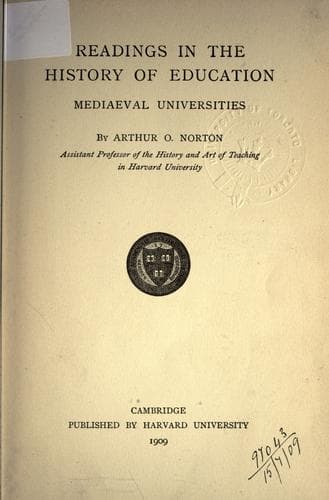
Readings in the History of Education: Mediaeval UniversitiesNorton, Arthur O.
History
Readings in the History of Education: Mediaeval Universities
Norton, Arthur O.
Education, Medieval -- History -- Sources; Universities and colleges -- Europe
The Code and the Institutes were known and studied in Italy throughout
the Dark Ages, but the Digest, much the largest and most important part
of the Corpus Juris, was almost wholly neglected, if not unknown, until
the time of Irnerius of Bologna (_c._ 1070-1130). He and his co-laborers
collected and arranged the scattered parts of the entire Body of Civil
Law, and in particular introduced the Digest to western Europe. "Without
the Digest the study of Roman Law was in a worse position than the study
of Aristotle when he was known only from the Organon." In a most
important sense, therefore, the recovery of the Corpus Juris was a
contribution of the twelfth century to the group of available higher
studies. Hitherto Law had been taught usually as a mere branch of
Rhetoric, and as a part of a liberal education. The body of material now
made available was sufficient to occupy the student's entire time for
several years. It therefore attained standing as an independent subject,
and as a distinctly professional study.
The effect of this newly recovered body of learning upon the rise of
universities was very much like that of Abelard and his new method.
Students flocked in thousands to study law at Bologna, and toward the
close of the twelfth century the University was organized. Numerous
other universities arose directly from the same impulse, and "Law was
the leading Faculty in by far the greater number of mediaeval
universities" (Rashdall). Except for Canon Law, the Corpus Juris Civilis
remained the chief study of the Faculties of Law for more than five
centuries. Roman Law is still very generally taught in European
universities. Thus the impulse given by Irnerius and his co-laborers is
influential in university affairs of to-day.
The influence of Roman Law upon the social and political history of
Europe is far-reaching. The subject is beyond the limits of the present
work; but it is to be noted that this influence was exerted as a result
of its study in the universities (see Rashdall, Vol. II, Pt. II, pp.
708-709).
Rashdall and Denifle think that the example of Justinian inspired the
first mediaeval grant of special privileges to scholars (see p. 82). If
this is true, the Roman Law had a most important effect upon the history
of universities themselves. Two important mediaeval privileges for
masters and scholars were exemption from taxation and the right of trial
before special courts. Whether or not these were copied from the Roman
Law is a question; but the Code of Justinian, following the statutes of
earlier emperors, explicitly grants both of these privileges to
teachers. These are so often mentioned that it is worth while to present
those bearing on the subject:
THE EMPERORS LEO AND ZENO, AUGUSTI, TO EUSEBIUS, MASTER OF
OFFICES.
Public-domain text, read in full here on John Shaqi.
Reviews
Reviews
No reviews yet
Be the first to share your thoughts on this work.
Join the Discussion
Join the discussion
Sign in to leave a comment or review.
Sign InorCreate an account