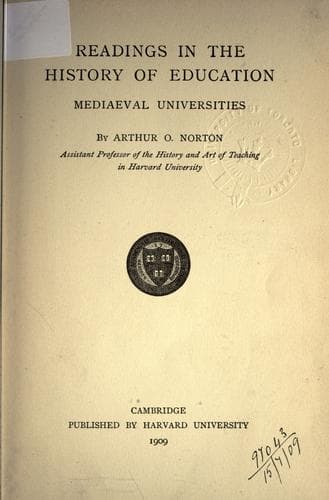
Readings in the History of Education: Mediaeval UniversitiesNorton, Arthur O.
History
Readings in the History of Education: Mediaeval Universities
Norton, Arthur O.
Education, Medieval -- History -- Sources; Universities and colleges -- Europe
By this law we decree that those who serve in the individual
schools, and who, after completing the curricula of their duties,
shall have reached the rank of chiefs and through the adored
purple of our divinity have won the dignity of most illustrious
Counts, shall enjoy both the girdle and all the privileges open
to them, and hereafter to their life's end shall be subject to
the court of Your Highness only, nor shall they be compelled by
the command of any one else whomsoever to undergo civil
litigation.
Yet in criminal suits and in matters connected with public
tribute we wish the appropriate jurisdiction of the rulers of the
provinces to be recognized against even such men, lest, under the
pretext of a granted privilege, either the influence of the
wicked be increased or the public good be diminished.[29]
THE EMPEROR CONSTANTINE, AUGUSTUS, TO THE PEOPLE.
We direct that physicians, and chiefly imperial physicians, and
ex-imperial physicians, grammarians and other professors of
letters, together with their wives and sons, and whatever
property they possess in their own cities, be immune from all
payment of taxes and from all civil or public duties, and that in
the provinces they shall not have strangers quartered on them, or
perform any official duties, or be brought into court, or be
subject to legal process, or suffer injustice; and if any one
harass them he shall be punished at the discretion of the Judge.
We also command that their salaries and fees be paid, so that
they may more readily instruct many in liberal studies and the
above mentioned Arts.
Proclaimed on the fifth day before the Kalends of October (Sept.
27) at Constantinople, in the Consulship of Dalmatius and
Zenophilas.[30]
(c) _Canon Law_
About 1142 (the year of Abelard's death) Gratian, a monk of Bologna,
doubtless influenced by the school of Roman Law in that city, made a
compilation of the Canon Law, which included the canons or rules
governing the Church in its manifold activities,--"its relations with
the secular power, its own internal administration, or the conduct of
its members." Hitherto Canon Law had been regarded as merely a
subdivision of Theology, just as Roman Law had been considered a branch
of Rhetoric. It now became an independent subject,--further addition to
the body of higher studies. As an influence upon the development of
universities it was not less important than the _Corpus Juris Civilis_.
The compilation made by Gratian was added to in later generations, and
the whole body of church law was known in the fifteenth century as the
_Corpus Juris Canonici_ (Body of Canon Law). Its main divisions are:
Public-domain text, read in full here on John Shaqi.
Reviews
Reviews
No reviews yet
Be the first to share your thoughts on this work.
Join the Discussion
Join the discussion
Sign in to leave a comment or review.
Sign InorCreate an account