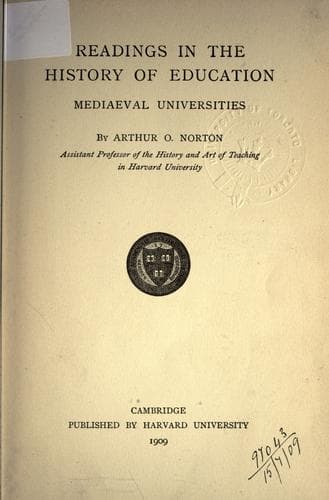
Readings in the History of Education: Mediaeval UniversitiesNorton, Arthur O.
History
Readings in the History of Education: Mediaeval Universities
Norton, Arthur O.
Education, Medieval -- History -- Sources; Universities and colleges -- Europe
1. The Decree of Gratian _(Decretum Gratiani)_ in three parts,
published c. 1142. Part I contains one hundred and one
distinctions (_distinctiones_) or divisions, which treat of
matters relating to ecclesiastical persons and offices. Dist.
XXXVII is translated below. Part II contains thirty-six cases
(_causae_) each of which is divided into questions
(_quaestiones_). These questions deal with problems which may
arise in the administration of the canon law. Part III contains
five distinctions which deal with the ritual and the sacraments
of the church. Under each distinction, or question, are arranged
the canons--the views of ecclesiastical authorities--on the
matter under discussion.
2. The Decretals (_Decretales_), in five books, published by Pope
Gregory IX in 1234.
3. The Sixth Book (_Liber Sextus_), a supplement to the Decretals
by Pope Boniface VIII, 1298.
4. The Constitutions of Clementine (_Constitutiones
Clementinae_), 1317.
5. Several collections of papal laws not included in those above,
known by the general title of _Extravagantes_, i.e., laws _extra
vagantes_, or outside of, the four compilations just mentioned.
Among all these the _Decretum_ of Gratian was the great innovation
which first marked out Canon Law as a distinct field of learning,
separate from both Theology and Roman Law. It was written as a
text-book; "it was one of those great text-books which take the world by
storm." It created an entirely new class of students, separate from
those devoted to Arts, Theology, Roman Law, and Medicine,--just as the
development of Engineering and other new professional studies have
created new groups of university students to-day,--and thereby increased
the resort to the universities.
Public-domain text, read in full here on John Shaqi.
Reviews
Reviews
No reviews yet
Be the first to share your thoughts on this work.
Join the Discussion
Join the discussion
Sign in to leave a comment or review.
Sign InorCreate an account