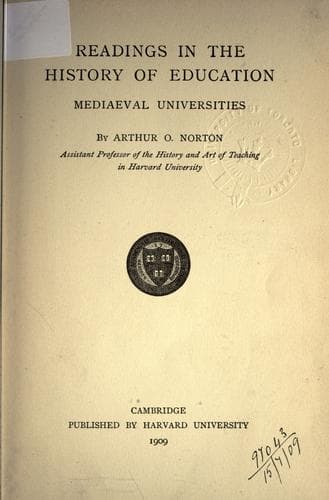
Readings in the History of Education: Mediaeval UniversitiesNorton, Arthur O.
History
Readings in the History of Education: Mediaeval Universities
Norton, Arthur O.
Education, Medieval -- History -- Sources; Universities and colleges -- Europe
In this mass of theological writings one book stands out as the
contribution which for three centuries most influenced university
instruction in theology. This is the "Sentences" _(Sententiae)_ of Peter
Lombard (c. 1100-1160), in four books. The subjects discussed in this
work are similar to those treated by Abelard in the _Sic et Non_ (see
p. 20). In not a few instances it adopts the form of presentation used
in that book, i.e., the citation of authorities on both sides of the
case. Like the _Decretum_ of Gratian, it is an illustration of the
widespread influence of the _Sic et Non._
A great number of commentaries were written upon this book. A manuscript
note in one of the copies in the Harvard library states that four
hundred and sixty such commentaries are known; but I have been unable to
verify the statement.
In theory, the Bible was studied in the Faculties of Theology in
addition to the "Sentences"; but in the thirteenth century and later it
seems to have occupied, in practice, a minor share of the student's
attention. To this effect is the criticism of Roger Bacon in 1292:
Although the principal study of the theologian ought to be in the
text of Scripture, as I have proved in the former part of this
work, yet in the last fifty years theologians have been
principally occupied with questions [for debate] as all know, in
tractates and summae,--horse-loads, composed by many,--and not at
all with the most holy text of God. And accordingly, theologians
give a readier reception to a treatise of scholastic questions
than they will do to one about the text of Scripture.... The
greater part of these questions introduced into theology, with
all the modes of disputation (see p. 115) and solution, are in
the terms of philosophy, as is known to all theologians, who have
been well exercised in philosophy before proceeding to theology.
Again, other questions which are in use among theologians, though
in terms of theology, viz., of the Trinity, of the fall, of the
incarnation, of sin, of virtue, of the sacraments, etc., are
mainly ventilated by authorities, arguments, and solutions drawn
from philosophy. And therefore the entire occupation of
theologians now-a-days is philosophical, both in substance and
method.[33]
(e) _Medicine_
Public-domain text, read in full here on John Shaqi.
Reviews
Reviews
No reviews yet
Be the first to share your thoughts on this work.
Elsewhere in the archive
Join the Discussion
Join the discussion
Sign in to leave a comment or review.
Sign InorCreate an account