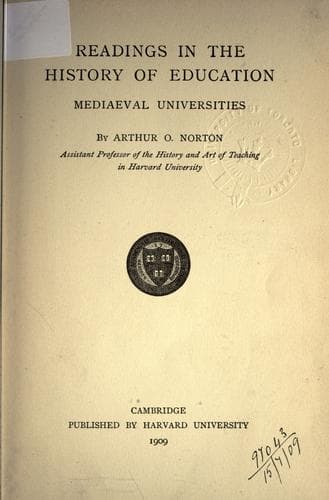
Readings in the History of Education: Mediaeval UniversitiesNorton, Arthur O.
History
Readings in the History of Education: Mediaeval Universities
Norton, Arthur O.
Education, Medieval -- History -- Sources; Universities and colleges -- Europe
Second, during the whole period under discussion there was an active
production of new text-books on the established subjects, some of which
were widely used in the universities. Among the grammars was the
_Doctrinale_ of Alexander da Villa Dei, written in 1199. This rhyming
grammar was enormously popular, and continued to be so, well into the
sixteenth century. The _Grecismus_ and _Labyrinthus_ of Eberhard of
Bethune (early thirteenth century), also grammars in rhyme, were widely
used. Logical treatises often mentioned in university programs of study
were _De Sex Principiis_ (On the Six Principles), written about 1150 by
Gilbert de la Porree, a teacher of John of Salisbury; and the _Summulae_
of Petrus Hispanus (thirteenth century). In the thirteenth century
Albertus Magnus made a digest of all the works of Aristotle, which
proved to be easier for students than the originals, and which were
sometimes used in place of them. Among mathematical works of this
century were the _Algorismus_ (Arithmetic) and the _Libellus de Sphaera_
(On the Sphere) by John Holywood (Sacrobosco); and the _Perspectiva
Communis_, i.e. Optics, by John (Peckham) of Pisa. A treatise on Music
by John de Muris of Paris was produced in the early part of the
fourteenth century. All of these were well-known university text-books.
They appear in the list at Leipzig throughout the fifteenth century (see
p. 139).
4. UNIVERSITY PRIVILEGES
The privileges granted by civil and ecclesiastical powers constitute a
fourth important influence upon the growth of universities. Beginning
with the year 1158 a long series of immunities, liberties, and
exemptions was bestowed by State and Church upon masters and students as
a class, and upon universities as corporations. Masters and scholars
were, for example, often taken under the special protection of the
sovereign of the country in which they were studying; they were exempted
from taxation, and from military service; most important of all, they
were placed under the jurisdiction of special courts, in which alone
they could be tried. Universities as corporations were given, among
other privileges, the right to confer upon their graduates the license
to teach "anywhere in the world" without further examination, and the
very important right to suspend lectures, i.e. to strike, pending the
settlement of grievances against State or Church. They had, of course,
the general legal powers of corporations. Thus fortified, the
universities attained an astonishing degree of independence and power;
and their members were enabled to live in unusual liberty and security.
This fact in itself unquestionably tended to increase the university
population.
Public-domain text, read in full here on John Shaqi.
Reviews
Reviews
No reviews yet
Be the first to share your thoughts on this work.
Elsewhere in the archive
Join the Discussion
Join the discussion
Sign in to leave a comment or review.
Sign InorCreate an account