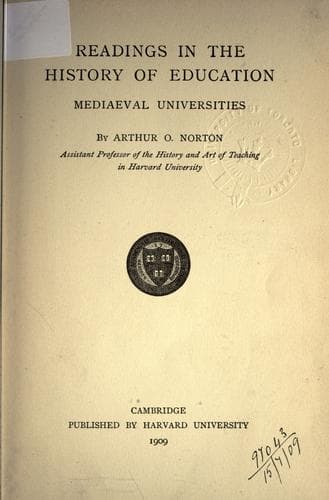
Readings in the History of Education: Mediaeval UniversitiesNorton, Arthur O.
History
Readings in the History of Education: Mediaeval Universities
Norton, Arthur O.
Education, Medieval -- History -- Sources; Universities and colleges -- Europe
rights, franchises, and liberties, of which by our said command,
foundation, and augmentation, you find them to be and to have
been duly possessed, without suffering anything to disturb or
interfere with this.
And, although in our other letters devoted to the regulation of
this University the said five bailiffs and seven messengers were
not in any way included, yet by special grace through these
present letters, to the end that our said University may be able
to have the servitors necessary to it, without whom the
requirements of study could not be continued and maintained, we
wish the said five bailiffs and seven messengers to enjoy such
and similar privileges as the rest who are named in our other
said letters of regulation, notwithstanding that the said letters
and any others whatever may require, or seem to require, the
contrary to this.
And that the aforesaid suppliants may be able to have, at their
need, these present letters in various and diverse places, we
wish that copies of these, made under the royal seal, be in good
faith made like the original.[44]
(d) _The Privilege of suspending Lectures_ (Cessatio)
One of the most effective privileges of mediaeval universities was the
right of suspending lectures. This was used again and again in cases of
unredressed grievances against civil or ecclesiastical
authorities,--more particularly against the former. A _cessatio_ was
usually followed by a migration of masters and scholars to some other
university, unless satisfaction was promptly forthcoming. Such a
migration was a serious blow to the commercial prosperity of any town;
consequently the "cessation" was an instrument of great power for the
extraction of all sorts of local concessions. It was often exercised
without express authorization by civil or ecclesiastical powers, but the
privilege was distinctly conferred by a bull of Pope Gregory IX for
Paris in 1231:
And if, perchance, the assessment [right to fix the prices] of
lodgings is taken from you, or anything else is lacking, or an
injury or outrageous damage, such as death or the mutilation of a
limb, is inflicted on one of you, unless through a suitable
admonition satisfaction is rendered within fifteen days, you may
suspend your lectures until you have received full satisfaction.
And if it happens that any one of you is unlawfully imprisoned,
unless the injury ceases on a remonstrance from you, you may, if
you judge it expedient, suspend your lectures immediately.[45]
Public-domain text, read in full here on John Shaqi.
Reviews
Reviews
No reviews yet
Be the first to share your thoughts on this work.
Elsewhere in the archive
Join the Discussion
Join the discussion
Sign in to leave a comment or review.
Sign InorCreate an account