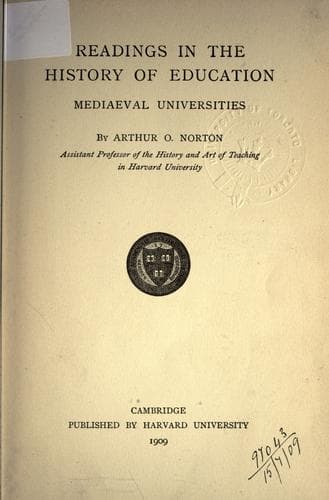
Readings in the History of Education: Mediaeval UniversitiesNorton, Arthur O.
History
Readings in the History of Education: Mediaeval Universities
Norton, Arthur O.
Education, Medieval -- History -- Sources; Universities and colleges -- Europe
Inasmuch as you have been presented to me for examination in both
[Civil and Canon] Laws and for the customary approval, by the
Most Illustrious and Most Excellent D.D. (naming the Promoters),
golden Knights, Counts Palatine, Most Celebrated Doctors, and
inasmuch as you have since undergone an arduous and rigorous
examination, in which you bore yourself with so much learning and
distinction that that body of Most Illustrious and Excellent
Promoters without one dissenting voice,--I repeat, without one
dissenting voice,--have judged you worthy of the laurel,
therefore by the authority which I have as Archdeacon and senior
Chancellor, I create, publish, and name you, N.N., Doctor in the
aforesaid Faculties, giving to you every privilege of lecturing,
of ascending the Master's chair, of writing glosses, of
interpreting, of acting as Advocate, and of exercising also the
functions of a Doctor here and everywhere throughout the world;
furthermore, of enjoying all those privileges which those happy
individuals, who have been so deserving in these fostering
colleges, are accustomed to use and enjoy.
And I trust that all these things will forever result in the
increase of your fame and the honor of our Colleges, to the
praise and glory of Almighty God and of the ever blessed Virgin
Mary.[67]
"In pursuance of the license thus conferred, he was then invested by the
Promoter with the _insignia_ of the teaching office, [the chair, the
book, the ring, the cap,] each, no doubt, with some appropriate formula.
He was seated in the Magisterial chair or _cathedra_. He was handed the
open book--one of the Law texts which it was his function to expound. A
gold ring was placed upon his finger, either in token of his espousal to
Science or in indication of the Doctor's claim to be the equal of
Knights; and the Magisterial _biretta_ placed upon his head: after which
the Promotor left him with a paternal embrace, a kiss, and a
benediction."[68] Then followed the triumphal procession homeward
through the town, "preceded by the three University pipers and the four
University trumpeters."
(d) _A Day's Work at Louvain in_ 1476
Documents which describe the day's work of a mediaeval student are not
common. A Ducal ordinance for the University of Louvain in 1476
indicates the way in which the student was supposed to work at that
institution.
Public-domain text, read in full here on John Shaqi.
Reviews
Reviews
No reviews yet
Be the first to share your thoughts on this work.
Elsewhere in the archive
Join the Discussion
Join the discussion
Sign in to leave a comment or review.
Sign InorCreate an account