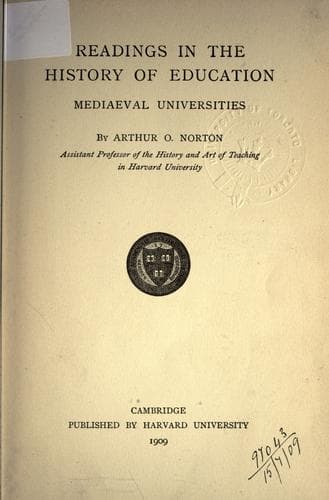
Readings in the History of Education: Mediaeval UniversitiesNorton, Arthur O.
History
Readings in the History of Education: Mediaeval Universities
Norton, Arthur O.
Education, Medieval -- History -- Sources; Universities and colleges -- Europe
[Footnote 61: Dante, _Quaestio de Aqua et Terra_, tr. A.C. White, pp.
VII-IX.]
[Footnote 62: Document printed by Rashdall, II, Pt. II, pp. 742-3.]
[Footnote 63: Rashdall, I, p. 226.]
[Footnote 64: Malagola, _Statuti_, etc., p. 116.]
[Footnote 65: _Acta Nationis Germanicae_, pp. 4, 8.]
[Footnote 66: Malagola, _Statuti_, etc., p. 116.]
[Footnote 67: Document printed by Rashdall, II, Pt. II, p. 734.]
[Footnote 68: Rashdall, I, p. 229.]
[Footnote 69: Document printed by Rashdall, Vol. II, Pt. II, p. 766.]
V
REQUIREMENTS FOR THE DEGREES IN ARTS
In general, the candidate for the A.B. degree must have taken part as
"respondent" or "opponent" (see p. 115) in a prescribed number of
disputations, and must have "heard" the lectures on certain prescribed
books before taking his examination for the degree. (This examination
seems, in some cases, to have been little more than a certification by a
committee of Masters that the student had fulfilled the foregoing
requirements.) The candidate for the degree of A.M. must have completed
further prescribed books and disputations, and must have "read," i.e.,
lectured upon, some book or books which he had previously "heard,"
before taking his examination for the License (to teach everywhere). No
general statement can be given as to the required number of
disputations; the practice differed at various times and places. The
Statutes of Leipzig required during the fifteenth century six "ordinary"
and six "extraordinary" responses from the prospective Bachelor. The
prospective Master was required to declare that he had been present at
thirty ordinary Bachelors' disputations, and had argued in each one "if
he had been able to get the opportunity to argue." The candidate for the
License at Paris, in 1366, must have attended disputations throughout
one "grand Ordinary," and must have "responded" twice. At Oxford the
youth must have taken part in disputations for a year as "general
sophister," and must have "responded" at least once, before taking the
A.B. or before "Determination," which was the equivalent of the A.B.
Prospective masters must have responded at least twice.[70]
The following lists of prescribed books give a good idea of mediaeval
requirements (aside from disputations) for the degrees of A.B. and A.M.,
at various times and places. The reader will note at once the
predominance of Aristotle, and the variations in requirements for the
degrees. Many similar lists might be cited from the records of other
universities; but they would give little additional information as
regards the degrees in Arts.
1. List of Books Prescribed for the Degrees of A.B. and A.M. at Paris,
1254.
The following list from the Statutes of 1254 does not separate the books
into the groups required for each degree, but indicates the total
requirement for both.
Public-domain text, read in full here on John Shaqi.
Reviews
Reviews
No reviews yet
Be the first to share your thoughts on this work.
Elsewhere in the archive
Join the Discussion
Join the discussion
Sign in to leave a comment or review.
Sign InorCreate an account