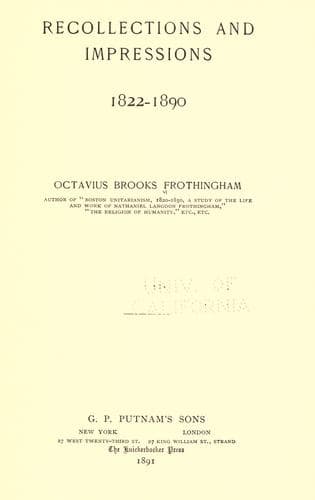
Recollections and Impressions, 1822-1890Frothingham, Octavius Brooks
Religion
Recollections and Impressions, 1822-1890
Frothingham, Octavius Brooks
Frothingham, Octavius Brooks, 1822-1895; Unitarians -- New England -- Biography
This passage illustrates well the tendency to personal reference that
distinguished the man. In a discourse on war delivered before the Peace
Society he resolves its miseries into those of the individual, as if
mass--affecting, as it does, nations, civilizations, humanity
itself--counted for nothing. This tendency explains his fondness for his
friends, his strength of sympathy, his tenacity of attachment, his love
for people. It does not betoken a broad, deep, philosophic mind, but it
does betoken a warm, clinging, affectionate nature.
It made him too a charming feature in society, a delightful talker, an
easy, graceful, delectable companion, an interested adviser and
counsellor, a beloved person in his family, an excellent townsman.
We should be grateful for this, that one has lived to irradiate a
somewhat sad profession, to warm the bleak spaces of mortal existence,
to throw a gleam of gladness upon the sunless problems of human destiny.
It is a great deal to be assured that a living heart has walked with us,
and that a living voice has proclaimed the heart-side of man's lot.
XIII. MY COMPANIONS.
These were many, but most of them are living and cannot, therefore, be
spoken of. There is an advantage in writing about the dead, for they
cannot protest against the handsome things you say, and they cannot
remonstrate against the unhandsome things. I shall on this account
choose but two, with whom I was very intimate, and who are very near to
my heart. I shall give sketches of John Weiss and Samuel Johnson, and
first of John Weiss.[*]
[*] Reprinted from the _Unitarian Review_ of May, 1888.
This man was a flame of fire. He was genius unalloyed by terrestrial
considerations; a spirit lamp always burning. He had an overflow of
nervous vitality, an excess of spiritual life that could not find vents
enough for its discharge. As his figure comes before me it seems that of
one who is more than half transfigured. His large head; his ample brow;
his great, dark eyes; his "sable-silvered" beard and full moustache; his
gray hair, thick and close on top, with the strange line of black
beneath it, like a fillet of jet; his thin, piping, penetrating, tenuous
voice, that trembled as it conveyed the torrent of thought; the rapid,
sudden manner, suggesting sometimes the lark and sometimes the eagle;
the small but sinewy body; the delicate hands and feet; the sensitive
touch, feeling impalpable vibrations and detecting movements of
intelligence within the folds of organization (they say he could tell
the character of a great writer by holding a sealed letter from his
hand),--all indicated a half-disembodied soul. His spoken addresses and
written discourses confirm the impression.
Public-domain text, read in full here on John Shaqi.
Reviews
Reviews
No reviews yet
Be the first to share your thoughts on this work.
Elsewhere in the archive
Join the Discussion
Join the discussion
Sign in to leave a comment or review.
Sign InorCreate an account