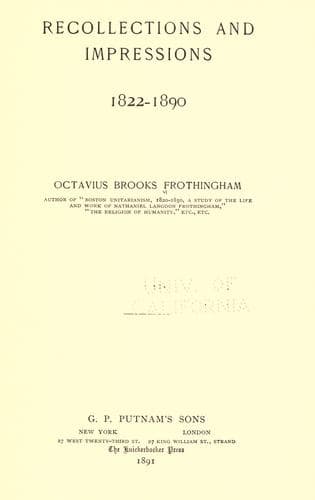
Recollections and Impressions, 1822-1890Frothingham, Octavius Brooks
Religion
Recollections and Impressions, 1822-1890
Frothingham, Octavius Brooks
Frothingham, Octavius Brooks, 1822-1895; Unitarians -- New England -- Biography
His genius was eminently religious. Not, indeed, in any customary
fashion, nor after any usual way. He belonged to the Rationalists, was a
Protestant of an extreme type, an avowed adherent of the most "advanced"
views, a speaker on the Free Religious platform, a writer for the
_Massachusetts Quarterly_, and for the _Radical_. His was a purely
natural, scientific, spiritual faith, unorthodox to the last
degree,--logically, historically, critically, sentimentally so,--so on
principle and with fixed purpose. The accepted theory of religion
excited his indignation, his scorn, his amazement, and his mirth. He
could brook no dogmatic limitations, even of the most liberal sect, but
went on and on, past all barriers, facing all adversaries, confronting
every difficulty, and resting only when there was nothing more to
discover. He had an agonized impatience to know whatever was to be
known, to get at the ultimate data of assurance. Nothing less would
satisfy him. His cup of joy was not full till he could touch the bottom.
Then it overflowed, and there was glee as of a strong swimmer who is
sure of his tide. His exultation is almost painful, as he welcomes fact
after fact, feeling more and more positive, with each new demonstration
of science, that the advent of certainty was by so much nearer. Evidence
that to most minds seemed fatal to belief was, in his sight,
confirmatory of it, as rendering its need more clear and more imperious.
"We need be afraid of nothing in heaven or earth, whether dreamt of or
not in our philosophy." "The position of theistic naturalism entitles it
not to be afraid of all the scientific facts that can be produced."
"There is dignity in dust that reaches any form, because it eventually
betrays a forming power, and ceases to be dust by sharing it." "It is a
wonder to me that scholars and clergymen are so skittish about
scientific facts." "We owe a debt to the scientific man who can show how
many moral customs result from local and ethnic experiences, and how the
conscience is everywhere capable of inheritance and education. He cannot
bring us too many facts of this description, because we have one fact
too much for him; namely, a latent tendency of conscience to repudiate
inheritance and every experience of utility, to fly in its face with a
forecast of a transcendental utility that supplies the world with its
redeemers, and continually drags it out of the snug and accurate
adjustment of selfishness to which it arrives." There is a great deal to
the same purpose. In fact, Mr. Weiss cannot say enough on this head. He
accepts the doctrine of evolution in its whole length and breadth. "Of
what consequence is it whence the living matter is derived? We are not
appalled at the possibility that organic matter may be made out of
non-living, or, more properly, inorganic matter. We are nerved for such
a result, whether it occur in the laboratory or in nature, by the
conviction that the spiritual functions are no more imperilled by using
Public-domain text, read in full here on John Shaqi.
Reviews
Reviews
No reviews yet
Be the first to share your thoughts on this work.
Elsewhere in the archive
Join the Discussion
Join the discussion
Sign in to leave a comment or review.
Sign InorCreate an account