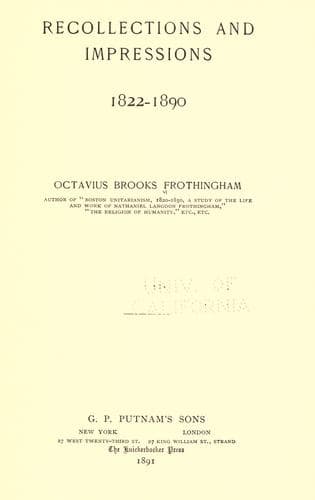
Recollections and Impressions, 1822-1890Frothingham, Octavius Brooks
Religion
Recollections and Impressions, 1822-1890
Frothingham, Octavius Brooks
Frothingham, Octavius Brooks, 1822-1895; Unitarians -- New England -- Biography
What a religious ecstasy is health! Its free step claims every
meadow that is glad with flowers; its bubbling spirits fill the cup
of wide horizons and drip down their brims; its thankfulness is the
prayer that takes possession of the sun by day and the stars by
night. Every dancing member of the body whirls off the soul to
tread the measures of great feelings, and God hears people saying:
"How precious also are thy thoughts, how great is the sum of them!
When I awake, I am still with thee." Yes,--when I awake, but not
before; not while the brain is saturated with nervous blood, till
it falls into comatose doctrines, and goes maundering with its
attack of mediatorial piety and grace; not while a stomach depraved
by fried food, apothecary's drugs, and iron-clad pastry (that
target impenetrable by digestion) supplies the constitution with
its vale of tears, ruin of mankind, and better luck hereafter. When
all my veins flow unobstructed, and lift to the level of my eyes
the daily gladness that finds a gate at every pore; when the
roaming gifts come home from Nature to turn the brain into a hive
of cells full of yellow sunshine, the spoil of all the chalices of
the earth beneath and the heavens above,--then I am the subject of
a Revival of Religion.
Or these passages about music, of which he was always a devoted lover,
a passionate admirer, an excellent critic. My first extract is used to
illustrate the doctrine of evolution, and suggests Browning's poem of
"Abt Vogler." It should be said, by the way, that Weiss was a great
student of Browning, whose lines in "Paracelsus," prophetic of the
evolution doctrine, was often on his lips. He even understood
"Sordello."
The divine composer, summoning instrument after instrument into his
harmony, climbed with his theme from those which offered but a
single note to those that exhaust the complexity of thought and
feeling, to combine them into expression, kindling through hints,
phrases, sudden concords, mustering consents of many wills,
releases of each one's felicity into comradeship, till the sweet
tumult becomes his champion, and bursts into an acclaim of a whole
world. "I ought--so then I will." The toppling instruments concur,
become the wave that touches that high moment, lifts the whole
deep, and holds it there.
Public-domain text, read in full here on John Shaqi.
Reviews
Reviews
No reviews yet
Be the first to share your thoughts on this work.
Elsewhere in the archive
Join the Discussion
Join the discussion
Sign in to leave a comment or review.
Sign InorCreate an account