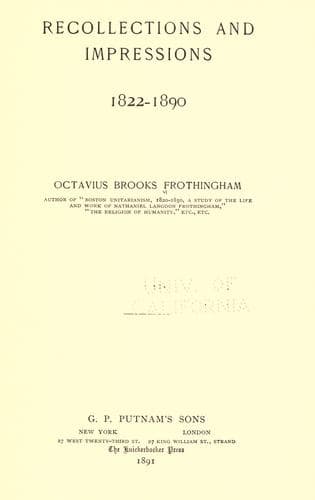
Recollections and Impressions, 1822-1890Frothingham, Octavius Brooks
Religion
Recollections and Impressions, 1822-1890
Frothingham, Octavius Brooks
Frothingham, Octavius Brooks, 1822-1895; Unitarians -- New England -- Biography
Samuel Johnson was an enthusiastic evolutionist, but of mind itself, not
of matter as ripening into mind. The ordinary conception of
evolution,--that the higher came from the lower,--was exceedingly
repugnant to him. Every kind of materialism he abhorred as illogical and
irrational. The theories of Comte,--that "mind is cerebration;" of
Haeckel,--that it is a "function of brain and nerve;" of Strauss,--that
"one's self is his body;" of Taine,--that a man is "a series of
sensations," were to him as absurd, in science or philosophy, as they
were fatal to aspiration and progress.
The crude definition of evolution as production of the highest by
inherent force of the lowest is here supplanted by one which
recognizes material parentage as itself involving, even in its
lowest stages, the entire cosmic _consensus_, of whose unknown
force mind is the highest known exponent.
He is alluding to Tyndall's statement that mind is evolved from the
universe as a whole, not from inorganic matter. For himself, he says:
Ideas were not demonstrated, are not demonstrable. No data of
observation can express their universal meaning.... What else can
we say of ideas than that they are wondrous intimacies of the soul
with the Infinite and Eternal, its contacts with universal forces,
its prophetic ventures and master steps beyond any past!... The
grand words, "I ought" refuse to be explained by dissolving the
notion of right into individual calculation of consequences, or by
expounding the sense of duty as the cumulative product of observed
relation of succession.... How explain as a "greater happiness
principle," or an inherited product of observed consequences, that
sovereign and eternal law of mind whose imperial edict lifts all
calculations and measures into functions of an infinite meaning?
And how vain to accredit or ascribe to revelation, institution, or
redemption, this necessary allegiance to the law of our being,
which is liberty and loyalty in one?
This is absolute enough. It is plain that to this writer the notion of
extracting intellect from form is ridiculous.
Public-domain text, read in full here on John Shaqi.
Reviews
Reviews
No reviews yet
Be the first to share your thoughts on this work.
Elsewhere in the archive
Join the Discussion
Join the discussion
Sign in to leave a comment or review.
Sign InorCreate an account