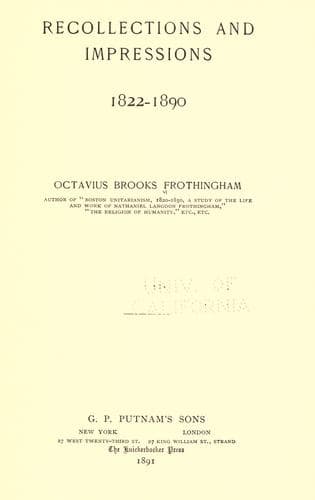
Recollections and Impressions, 1822-1890Frothingham, Octavius Brooks
Religion
Recollections and Impressions, 1822-1890
Frothingham, Octavius Brooks
Frothingham, Octavius Brooks, 1822-1895; Unitarians -- New England -- Biography
George Ripley had a passion for literary excellence. From his boyhood
he possessed a singularly bright intelligence, a clear appreciation of
the rational aspect of questions. He was not an ardent, passionate,
enthusiastic man, of warm convictions, vehement emotions, burning ideas.
His feelings, though amiable and correct, were of an intellectual cast.
They sprang from a naturally affectionate heart, rather than from a
deeply stirred conscience, or an enchanted soul. If he had been less
healthy, eupeptic, he would scarcely have been so gay; a vehement
reformer he was not; a leader of men he could not be. He had not the
stuff in him for either. The element of giving was not strong in him. He
was not an originator in the sphere of thought; not a discoverer of
theories or facts; not an innovator on established customs. But mentally
he was so quick, eager, receptive, that he seemed a pioneer, an
enthusiast, a saint; his quickness passing for insight, his eagerness
for a passionate love of progress, his receptivity for charitableness.
He appeared to be more of an image-breaker than he really was. In fact,
the propensity to iconoclasm was not part of his constitution. But his
mind was wonderfully alert. He had his antipathies, and they were strong
ones, his likes and dislikes, his tastes and distastes, but these were
instinctive rather than the expression of rational principle or a
deliberate conclusion of his judgment. In one instance that I know of,
he threw off a man with whom he had been associated for many years, and
in connection with whom he labored daily for a time, a very accomplished
and agreeable person to whom he was indebted for some services, because
he thought that the individual in question had been unjust to some of
his friends; but that this was not entirely a matter of conscience would
seem to be indicated by the fact that he sent a message of affection to
this man, as he neared the grave. In the main, so far as he was under
control, intellectual considerations determined his course. He was
prevailingly under the influence of mind; he acted in view, a large
view, of all the circumstances; as one who takes in the whole situation,
and has himself under command. This is not said in the least tone of
disparagement, but entirely in his praise, for the supremacy of reason
is more steady, even, reliable than the supremacy of feeling however
exalted in its mood. He that is under the control of mind is at all
times _under control_, which cannot be said of one who is borne along by
the sway of even devout emotion. I have in memory cases where passion
might have betrayed Mr. Ripley into conduct he would have regretted, had
it not been for the restraining power of purely rational considerations.
His early religious training may have produced some effect on his
character, but this is more likely to have operated at first than at the
later stages of his career. The love of old hymns, the habit of
Public-domain text, read in full here on John Shaqi.
Reviews
Reviews
No reviews yet
Be the first to share your thoughts on this work.
Elsewhere in the archive
Join the Discussion
Join the discussion
Sign in to leave a comment or review.
Sign InorCreate an account