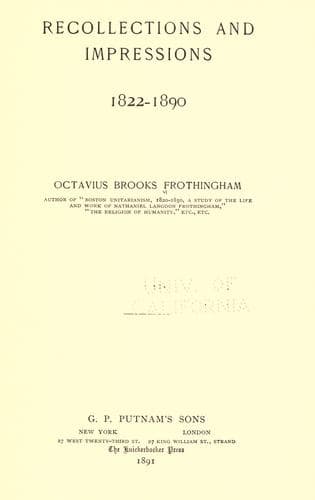
Recollections and Impressions, 1822-1890Frothingham, Octavius Brooks
Religion
Recollections and Impressions, 1822-1890
Frothingham, Octavius Brooks
Frothingham, Octavius Brooks, 1822-1895; Unitarians -- New England -- Biography
We do not know whether the grave is the end of this life or the
door of another, or whether the night here is somewhere else a
dawn. The idea of Immortality, that like a sea has ebbed and flowed
into the human heart with its countless waves beating against the
shores and rocks of time and faith, was not born of any book or of
any creed or of any religion. It was born of human affection, and
it will continue to ebb and flow beneath the mists and clouds of
doubt and darkness as long as love kisses the lips of death. It is
the rainbow, Hope, shining upon the tears of grief.
Paine's simple childlike belief in God and Immortality, Ingersoll
remands to the cloudy sphere of agnosticism, as Paine probably would
now; but it is my opinion that if evidence which he regarded as
satisfactory--that is, legal evidence--could be given, he, too, would
accept these articles; for he has none of the elements of the bigot
about him. His detestation is simply of hell and a priesthood; for pure,
spiritual religion, he has only respect. Like Paine, he attacks the
ecclesiasticism and theology of the day, and is satisfied with doing
that; and, like Paine, he has convictions instead of opinions, and his
character is all aflame with his ideas.
In his private life, in his family relations, in his public career,
there is no reproach on his name--nothing that he need be ashamed of.
Mr. Ingersoll does not worship the Infinite under any recognized form or
name, but that he adores the _substance of deity_ is beyond all doubt;
he worships truth and purity and sincerity and love,--everything that is
highest and noblest in human life. One word more I must say,--that his
motive is essentially religious. It is his aim to lift off the burden of
superstition and priestcraft; to elevate the soul of manhood and
womanhood; to promote rational progress in goodness; to emancipate every
possibility of power in the race; and this is the aim of every pure
religion,--to open new spheres of hope and accomplishment.
The disintegration of the popular orthodoxy goes on very fast, and
always under the influence of the moral sentiment. This is very prettily
put by Miss Jewett, in one of her short stories, entitled "The Town
Poor." Two ladies, jogging along a country road, fall to talking about
an old meeting-house which is being _improved_ after the modern fashion.
One of them laments the loss of the ancient pews and pulpit, and the
substitution of a modern platform and slips. The other says:
Public-domain text, read in full here on John Shaqi.
Reviews
Reviews
No reviews yet
Be the first to share your thoughts on this work.
Elsewhere in the archive
Join the Discussion
Join the discussion
Sign in to leave a comment or review.
Sign InorCreate an account