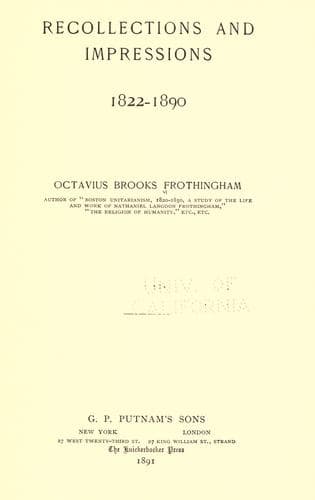
Recollections and Impressions, 1822-1890Frothingham, Octavius Brooks
Religion
Recollections and Impressions, 1822-1890
Frothingham, Octavius Brooks
Frothingham, Octavius Brooks, 1822-1895; Unitarians -- New England -- Biography
Of Unitarianism, after what has been said, it is unnecessary to speak.
That there should be a difference between the East and the West is
natural. The East holds fast, in large sense, to the ancient theological
traditions. The West never had them, and can therefore declare that its
fellowship is conditioned on no doctrinal tests, and can welcome all who
wish to establish truth and righteousness and love in the world. The
West will ultimately prevail; the temper of the East is rapidly wasting
away, and the breach will soon be closed up. The new Unitarian churches
will be founded on a practical basis, the only requirement being that
the minister should be deeply in earnest about religious things. The
characteristic of all churches, of whatever name, is an urgent interest
in social reform, a deep concern for the disfranchised and oppressed,
and a warm feeling towards the elevation of mankind. The universal
prayer is, to borrow the pithy language of Dr. F. H. Hedge: "May Thy
kingdom come on earth!" not "May we come into Thy kingdom."
If it was hard to do full justice to Thomas Paine, it is harder to do
full justice to the Broad Churchman. There is no authoritative account
of his position to which appeal can be made, and the great variety of
opinion on incidental points makes it difficult to frame any description
which the leaders would accept. A great deal depends on the change of
circumstances, the ruling spirit of the time, the prevailing tendencies
of thought in the period,--whether scientific, critical, or social,--and
a great deal depends, too, on the peculiarities of individual
temperament, but the fundamental doctrines are the same. The ordinary
observer can see the largeness, sympathy, inclusiveness, devotion to
actual needs. But the ordinary observer cannot see the real basis of
faith in human nature; the manifestation of the Divine Being in the
highest possibilities of man; the trust in a living, active,
communicating God.
These are cardinal points, and must be insisted on. The inherent
depravity of man; his essential corruption; his absolute inability to
receive any portion of the divine life, is naturally repudiated. But his
feebleness, crudeness, imperfection, his dearth and deficiency, his
sensuality, hardness, love of material things, is insisted on, and
cannot be exaggerated. Still there is a germ of the divine nature in
him, a spark of the divine flame which can be kindled. The familiar
language of Longfellow expresses this idea exactly:
"Ye whose hearts are fresh and simple,
Who have faith in God and Nature,
Who believe that in all ages
Every human heart is human,
That in even savage bosoms
There are longings, yearnings, strivings
For the good they comprehend not,
That the feeble hands and helpless,
Groping blindly in the darkness,
Touch God's right hand in that darkness
And are lifted up and strengthened:--
Listen to this simple story."
Public-domain text, read in full here on John Shaqi.
Reviews
Reviews
No reviews yet
Be the first to share your thoughts on this work.
Elsewhere in the archive
Join the Discussion
Join the discussion
Sign in to leave a comment or review.
Sign InorCreate an account