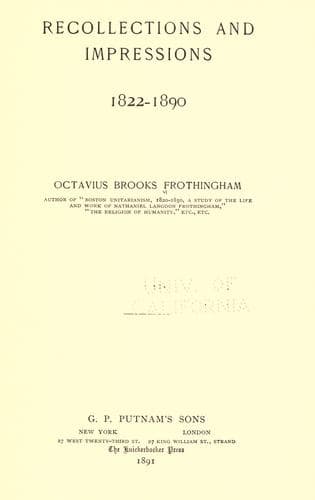
Recollections and Impressions, 1822-1890Frothingham, Octavius Brooks
Religion
Recollections and Impressions, 1822-1890
Frothingham, Octavius Brooks
Frothingham, Octavius Brooks, 1822-1895; Unitarians -- New England -- Biography
At this point, the conception of the Broad Churchman's idea of the
inspiration of the Scripture must be dwelt upon, for the doctrine is
very remarkable, and throws a flood of light upon his whole conception
of the aim and purpose of Christianity. According to the common notion,
the Bible is literally the word of God, and men have nothing to do but
to submit themselves to its authority. They must suppress all natural
desires, all dictates of their moral sense, to this supreme standard of
truth and rectitude. According to this notion, the whole of man, as a
thoroughly corrupted being, is _subject_, in obedience to this law. The
second theory, adopted by the American Broad Churchman, holds that the
Bible _contains_ the word of God; and this implies that there may be a
part of the Bible that is not the word of God, and opens the way to an
indefinite amount of criticism, speculation, and doubt. The English
Broad Churchman holds, as I understand it, the common doctrine, but with
this immense difference. That whereas, according to the common notion,
the Bible is the word of God, he maintains that the whole object of the
Bible is to educate and uplift man. The word is a minister to human
needs. Through it, God is trying in various ways, by history, biography,
tale, and song, to warn, persuade, teach, inspire the human soul.
Sometimes he can do nothing but startle, shame, provoke; and the very
things we find fault with may be designed for moral education. The
Bible, itself, encourages this idea. Does not Paul preach
reconciliation? Does not John speak of God as love? God hardened the
heart of Pharaoh in order that he might show that He was stronger than
Pharaoh. Jacob was not altogether a lovely character, but the Lord
wrestled with him and lamed him, thus showing his own disapproval of the
patriarch's temper. David was a seducer, adulterer, and murderer, but he
_repented_, was ashamed, was sorrowful, and this repentance made him a
man after God's own heart. It was not that God _approved_ of his
conduct, but that he wanted to make us _disapprove_ of it. In like
manner Luther based his faith on the Bible, because it convicted him of
sin, and drove him to seek refuge for himself in Christ. The Church as
an organization has always this one purpose in view--to minister to the
soul of man. The "Articles" fairly throbbed with this conception. The
outrage committed by the "Evangelicals," men who insist upon everlasting
punishment and talk of doom, consists in their overlooking this divine
purpose towards humanity.
Public-domain text, read in full here on John Shaqi.
Reviews
Reviews
No reviews yet
Be the first to share your thoughts on this work.
Elsewhere in the archive
Join the Discussion
Join the discussion
Sign in to leave a comment or review.
Sign InorCreate an account