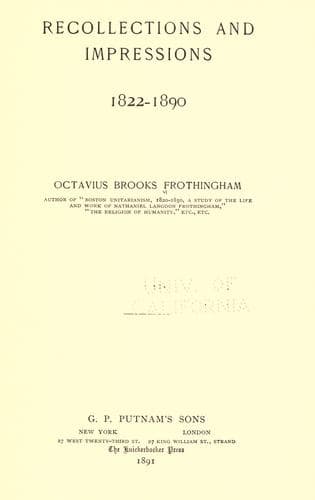
Recollections and Impressions, 1822-1890Frothingham, Octavius Brooks
Religion
Recollections and Impressions, 1822-1890
Frothingham, Octavius Brooks
Frothingham, Octavius Brooks, 1822-1895; Unitarians -- New England -- Biography
There is certainly a great difference between the Broad Church in
America and the Broad Church in England; there are no Thirty-Nine
Articles in this country; there is no National Church. The Broad
Churchman here is still a Churchman, but the system is much more elastic
and much more intellectual. The Church is to him also a divine
institution, but not a final establishment; and it becomes divine by
virtue of its helpfulness in imparting the divine life and its power of
human service. The sacraments have become symbols, venerable from their
antiquity, but more venerable from their use. The Broad Churchman is an
orthodox believer, but he accepts only the simplest creeds, and he
interprets them in accordance with the rational principles of thought,
and with his fundamental conception of Christianity, holding not to the
written letter, but to the real meaning of the Confession. This meaning
is, he maintains, easily reconcilable with the idea that all revelation
is made to a living mind,--whether that of a race or an individual,--and
that the Bible is merely the record of it. No _book_, in his estimation,
can be inspired. This, coupled with a belief in the unlimited progress
of the natural conscience, brings the system within the category of
modern arrangements.
The idea that man is _developed_ into the divine life, not _converted_
to it, seems to be the heart of the system. The writings of F. D.
Maurice are full of it. He said that he did not know what the Broad
Church was, and disclaimed any position in it; yet he is its reputed
father, and certainly held its cardinal doctrine. This was the soul of
his teaching; this dictated his likes and his dislikes; this animated
his dissent from the Evangelicals on the one hand and the Rationalists
on the other; this made him cling to the "Articles"; this made him love
the Church. I cannot better convey my notion of the Broad Churchman's
credence than by quoting some passages from Maurice:
I think that the _ground-work of this thought_ and this humanity
_is laid bare_ in the Thirty-nine Articles; _that for that
ground-work_ [namely, the living God, the living Word] all our
different schools are trying to produce feeble and crumbling
substitutes; that we must recur to it if we would pass the narrow
dimensions of Calvinism, Anglicanism, Romanism; if we would learn
what a message we have for Jews, Mahometans, Brahmins, Buddhists,
for all the nations of the earth, as well as our poor people at
home.
I cannot doubt that this belief [the confession of a God, who was,
and is, and is to come] is latent in every man now; that we are all
living, moving, having our being in this God, and that He does
reveal Himself to His creatures gradually, before He is revealed in
His fulness of glory.
Public-domain text, read in full here on John Shaqi.
Reviews
Reviews
No reviews yet
Be the first to share your thoughts on this work.
Elsewhere in the archive
Join the Discussion
Join the discussion
Sign in to leave a comment or review.
Sign InorCreate an account