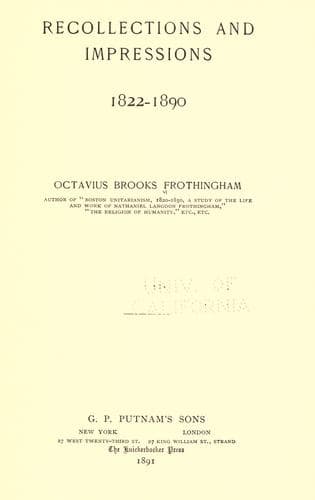
Recollections and Impressions, 1822-1890Frothingham, Octavius Brooks
Religion
Recollections and Impressions, 1822-1890
Frothingham, Octavius Brooks
Frothingham, Octavius Brooks, 1822-1895; Unitarians -- New England -- Biography
But supposing that such an alteration is possible, that the church can
abase its pretensions to supremacy over all other sects, that Romanism
simply melts into our society,--in this case, the papacy, as usually
understood, becomes simply a form of church government like
Presbyterianism or Congregationalism or Episcopacy; Catholicism becomes
a purely spiritual faith, and, as such, is not only harmless but
beneficent.
The religion, therefore, of America cannot be ecclesiastical; neither
can it be dogmatic. I was on the point of saying _theological_; but
there is a great difference between theological and dogmatical.
Dogmatism is theology raised to power. Theology there always must be;
some account of the Supreme Power in the world; some report of the
contents of the Divine Mind. The present indifference to theology is
hardly a good sign, unless it be an indifference to theology as usually
regarded--that is, to the old systems of theology. The future religion,
for this reason, cannot be Protestantism. For Protestantism is
essentially dogmatical. It claims superiority to Romanism on the one
hand and to infidelity on the other. Furthermore, it is identified with
the Bible. Now, modern scientific criticism has so riddled the Bible,
that it no longer can serve as a foundation. And this foundation being
taken away, Protestantism must lose its corner-stone, and rest entirely
on a rational basis. Likewise, Protestantism encourages sectarianism. It
exists, in fact, only in numerous parties, each jealous of the rest and
seeking to build up its own establishment without regard to the
well-being of opposing bodies. There is a dream of unity amid all this
diversity. But such unity can be gained only by the sacrifice of the
very peculiarity of division, and the admission of certain things which
all have in common; and such a reconciliation, besides the tyranny it
engenders, cannot be desired, as it would be fatal to all activity.
Sectarianism itself, apart from the "hatred, malice, and
uncharitableness" which accompany it, may not of necessity be an evil;
but sectarianism as it exists now is an evil of very great moment, and
yet, without something of this alienation between sects Protestantism
would decline.
Public-domain text, read in full here on John Shaqi.
Reviews
Reviews
No reviews yet
Be the first to share your thoughts on this work.
Elsewhere in the archive
Join the Discussion
Join the discussion
Sign in to leave a comment or review.
Sign InorCreate an account