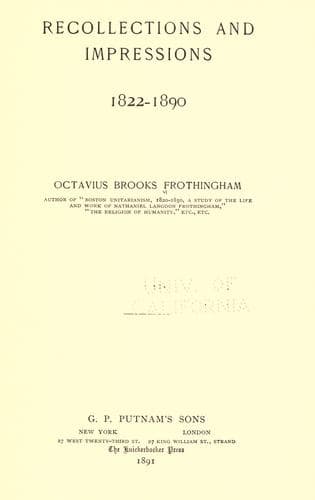
Recollections and Impressions, 1822-1890Frothingham, Octavius Brooks
Religion
Recollections and Impressions, 1822-1890
Frothingham, Octavius Brooks
Frothingham, Octavius Brooks, 1822-1895; Unitarians -- New England -- Biography
Cannot the power which sustains, without budging from the spot, my
personal vitality, sustain and nourish the immediate conscience of
which that vitality makes me aware? I cannot hurt my health, nor
tell a lie, nor commit a fraud, nor strike my brother, nor leave
the beggar in the ditch, nor parade my superiorities, without
knowing it by direct intimation. My pains are its rebukes, my
delights its sympathies, my hopes its suggestions, my sacrifices
its impost, my heavenly longings its apology for haunting me
forever. There is a power in which I live and move and have my
being, in which I eat, drink, breathe, sleep, wake, love and hate,
marry, and protect a home. Is it incapable of sustaining all my
functions of true religion on the spot as well as these? Do I have
these without a mediator, and must I travel for the rest? When I
undertake to breathe by tradition it will be time for me to get a
sense of God in the same way.
The Dignity of Human Nature must be our watchword; of human _nature_,
not of human _character_. For human _nature_ denotes the _capacities_ of
man, what he _ought_ to be and _shall_ be, not what he _is_. Human
character expresses only the undeveloped condition of man, and is
therefore not to be taken as a final stand. This doctrine does not
belong to a sect or a church, but to all mankind. It assumes an entirely
new conception of the basis of religious faith; it makes a new
beginning; it starts a new system; it exactly reverses the ancient order
of thought, and builds up from a completely original foundation.
The weightiest objections proceed from the undeveloped character of
man. For example, the common saying that conscience is crude, confused,
either does not exist at all, or erects inconsistent standards of right
and wrong. But if a high criterion of morality is established, as it is,
it has an educating and sustaining power. Every saint attests it; all
the bibles of the world voice it; revelation owes to it its authority.
Great souls do but raise the common level on which common souls tread;
as the discovery of the ancient pavements in the Forum at Rome opens to
ordinary feet the way that statesmen and heroes went. When I was in
Salem, a young man who was very much addicted to drink, being
remonstrated with, urged that he could not help it, that he was born so,
just as another was born to praise and pray. His appetite for ardent
spirits was just as natural to him as the preacher's appetite for
spiritual things. His argument could not be refuted, but I always
thought that in his hours of reflection, if he had any, he must have
despised himself. At all events, the outside observer would class him
with a lower order of humanity; the fixed rule of conscience being a
universal judge.
Public-domain text, read in full here on John Shaqi.
Reviews
Reviews
No reviews yet
Be the first to share your thoughts on this work.
Elsewhere in the archive
Join the Discussion
Join the discussion
Sign in to leave a comment or review.
Sign InorCreate an account