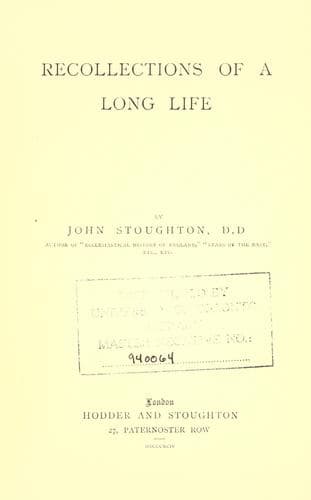
Clergy -- England -- Biography; Stoughton, John, 1807-1897
Dr. Adams of New York, an eminent Presbyterian pastor, delivered an
address of welcome. Elaborate yet unaffected, scholarly yet not
scholastic, fervent yet not rhapsodical, fluent yet perfectly finished,
pious without a particle of fanaticism,—it laid hold on people present,
and made an impression talked of to this day. I have heard many a
courteous speech at the opening of large assemblies, but never any thing
like that, before or since.
The address of welcome was acknowledged in a hearty, but inferior style,
by English, French, Dutch, and German delegates. “I am glad,” said
Professor Christlieb, the German, grasping the hand of Pastor Fisch, the
Frenchman, “I am glad to see as the firstfruits of this gathering, that
we Germans can clasp the hands of our French brethren.”
The next morning we assembled in Steinway Hall. After prayer by Dr.
Hodge of Princeton, Dr. Woolsey, Ex-President of Yale College, a
distinguished student of International Law, took the chair. The Dean of
Canterbury, Dr. Payne Smith, read a sympathetic letter from the English
Primate, and immediately after prayer, he solemnly repeated the Apostles’
Creed, in which the whole assembly followed in audible tones.
The Conference then began with the reading of papers, which, with
addresses, were continued morning and evening at sectional meetings. The
interest was kept up, attention never seeming to flag. When Sunday came,
large churches were crowded to excess. The Holy Communion was
administered in the afternoon, when Episcopal, Presbyterian, Baptist,
Moravian, and Indian brethren took part in the service.
Besides the sectional conventions, an enormous general meeting was held
in Brooklyn, when extempore addresses were delivered in free and easy
style. But perhaps the most deeply affected audience was a crowded one
in the Academy of Music the last Sunday night, for prayers and short
addresses. A prima donna, I heard, was present: certainly there was one
voice of pre-eminent sweetness and power in that vast congregation.
All the newspapers gave reports of the proceedings as fully as _The
Times_ does of our parliamentary debates. One afternoon two gentlemen,
who had been clergymen, spent some time beforehand in preparing a report
of what I meant to say in the evening. There was no other way, _they
said_, of getting the report ready for the next morning. The interest
taken in our proceedings by all classes greatly surprised me.
Newspapers, representative of churches out of sympathy with our
proceedings, noticed and criticised what went on: the secular press also
took up the matter, and conveyed abundant information. What appeared in
New York papers was transferred to others all over the States, and thus
religious news of that week spread far and wide.
Public-domain text, read in full here on John Shaqi.
Reviews
Reviews
No reviews yet
Be the first to share your thoughts on this work.
Elsewhere in the archive
Join the Discussion
Join the discussion
Sign in to leave a comment or review.
Sign InorCreate an account