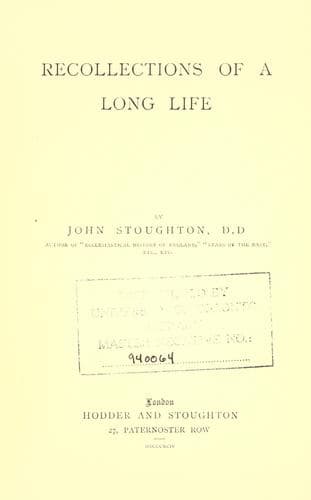
Clergy -- England -- Biography; Stoughton, John, 1807-1897
For Archbishop Tait I had great respect and affection. He was singularly
kind and conversable, without affecting any official superiority. Under
his grave countenance, and habitually serious demeanour, as one who lived
ever “in his Great Taskmaster’s eye,” there were veins of cheerfulness
and humour in his familiar intercourse—I felt deeply, his gentle
sympathy, expressed in a letter of condolence, on my dear wife’s death;
and the last time we talked together, being interrupted by another
person, he broke off in the opening of what seemed an amusing tale. He
appreciated the relative position of Church and Dissent, better than any
other dignitary I have met with. He would say that Nonconformists had
their traditions, organisations, endowments, and influence, which gave
them a status they were not likely to surrender by bringing over what
belonged to them, into an Episcopalian organisation. A fraternal _modus
vivendi_, he regarded as the object to be aimed at, not an absorption of
Dissenting bodies into the Establishment. He, no doubt, would have
preferred to see _One Great Church_ in England, under a moderate
Episcopacy; but he seemed to cherish little hope of any such object being
accomplished.
On a former page allusion was made to Mr. Bagster, of Polyglot fame. In
the year (1877) his venerable wife, at the age of 100 _within a few
hours_, died at Old Windsor; and her accumulated years attracted the
notice of Her Majesty, who honoured her with a visit just before her
decease. I called at the cottage in which she expired, after the royal
visitor had been there, and there heard the particulars of the interview.
Her Majesty I was informed, brought with her the Princess Beatrice; and,
on their entrance into the bedroom, where the old lady was lying, she at
once expressed her gratitude for the signal favour bestowed by her
Sovereign, saying that “she was looking forward to her own speedy
dismissal to the immediate presence of the Saviour, where she hoped
hereafter to meet Her Majesty.” Pleasant conversation followed, in which
Mrs. B., at the Queen’s request, related her memories of George III.,
Queen Charlotte, and the Royal Family, as they used to walk on the Castle
terrace, in the presence of a large number of loyal spectators. The
Queen manifested interest in particulars respecting the good old lady,
related by her daughter; and in consequence of the report she gave on her
return home, Prince Leopold, as I was told soon afterwards, paid a visit
to Old Windsor, and wished for a rehearsal of what had been communicated
by his Royal Mother. Repeated gracious inquiries from the Castle
followed. At the funeral service a note was put into my hands, written
by the Duchess of Roxburgh to Miss Bagster, tenderly touching on that
lady’s sorrow, for her late bereavement; and concluding with the words:
“The Queen begs you to convey to all the members of your venerable
mother’s family, the assurance of Her Majesty’s condolence.” This note
Public-domain text, read in full here on John Shaqi.
Reviews
Reviews
No reviews yet
Be the first to share your thoughts on this work.
Elsewhere in the archive
Join the Discussion
Join the discussion
Sign in to leave a comment or review.
Sign InorCreate an account